 ›
›
Measuring physical quantities
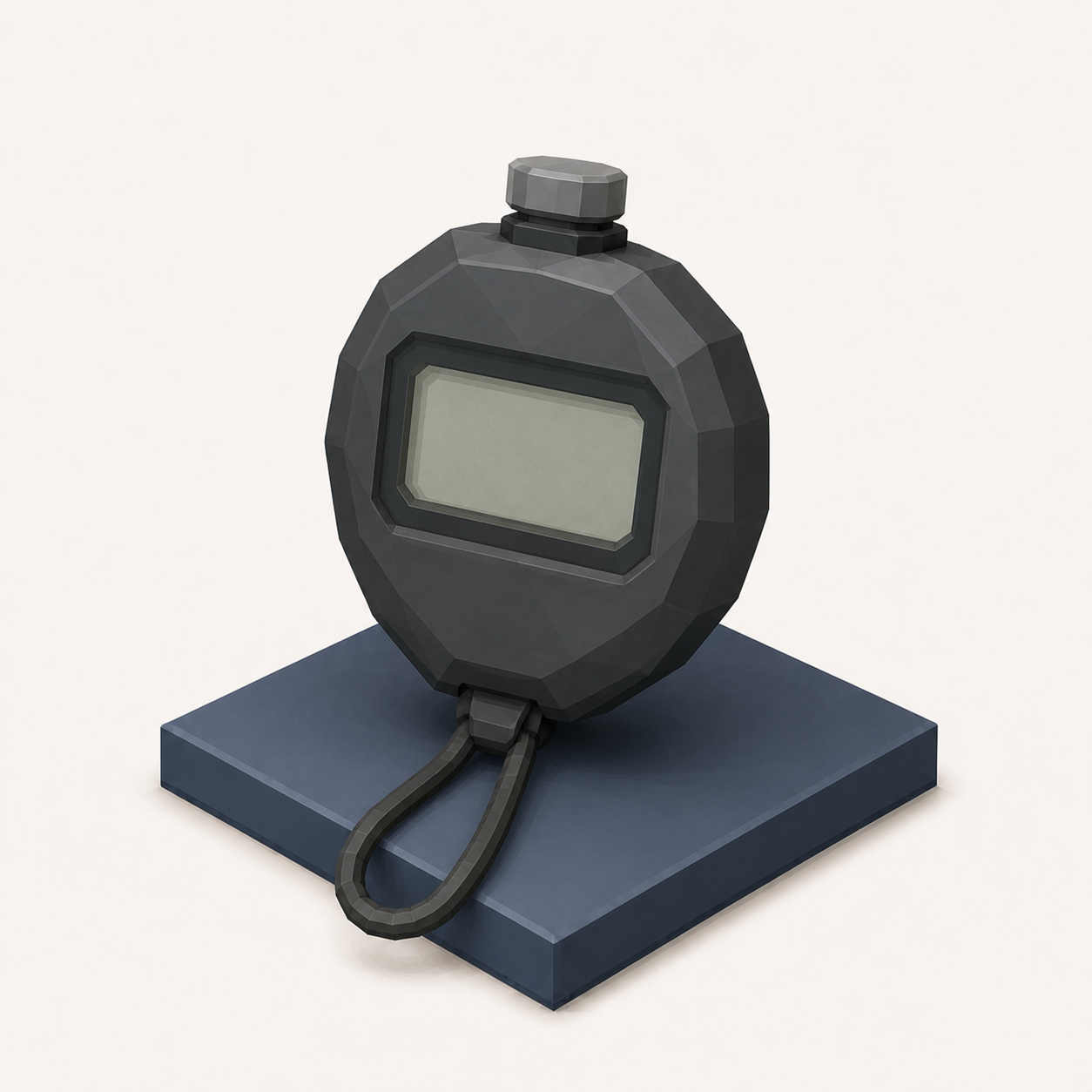
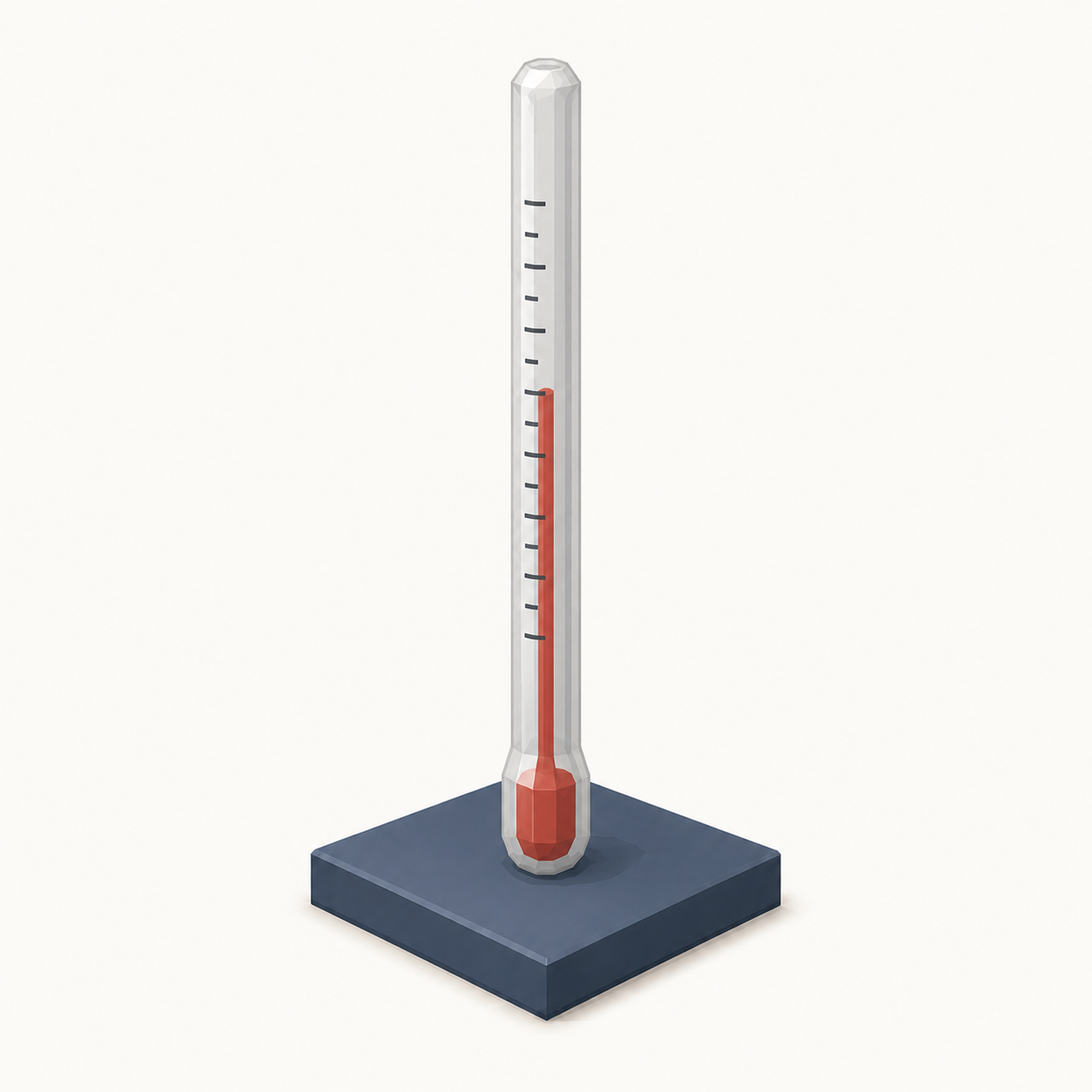
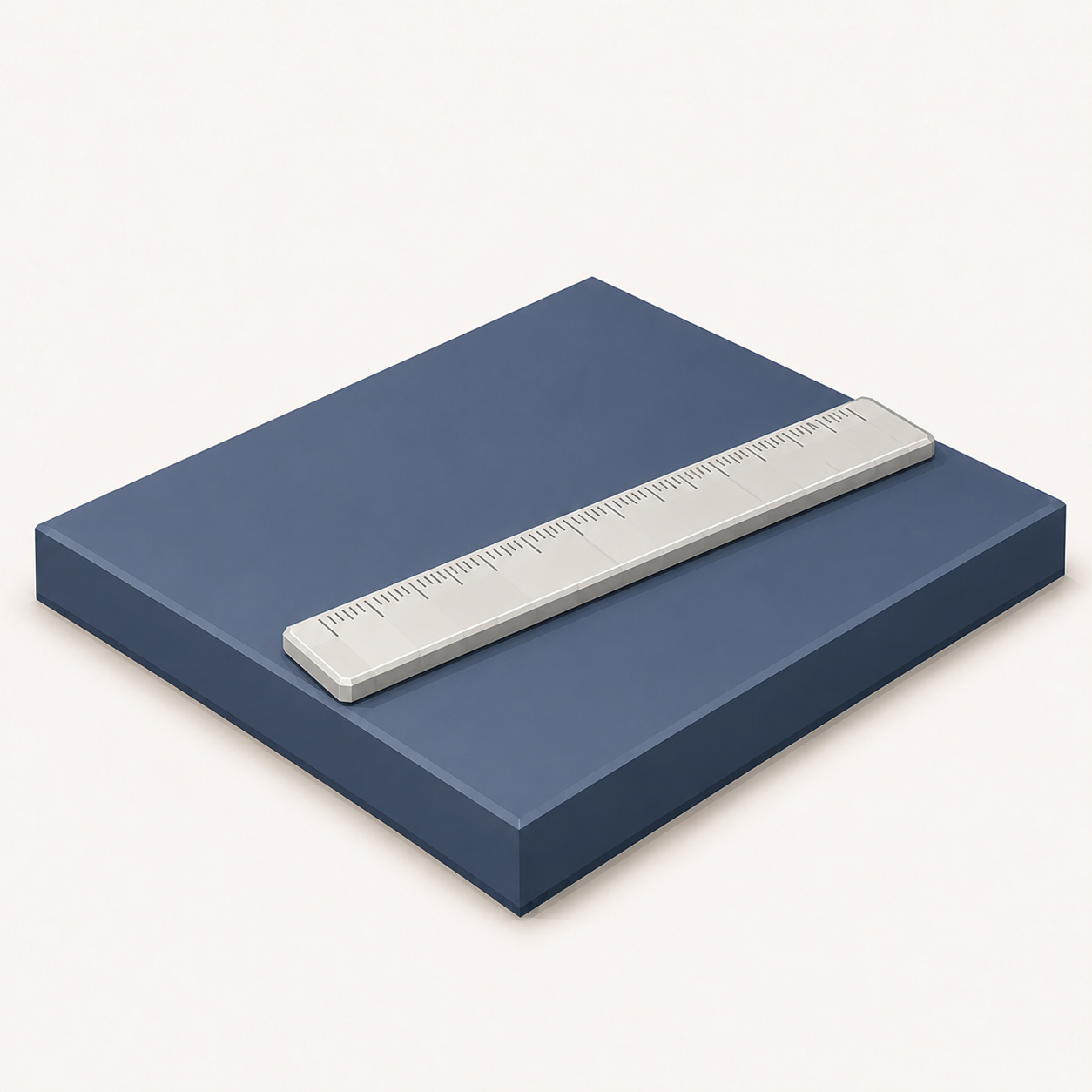
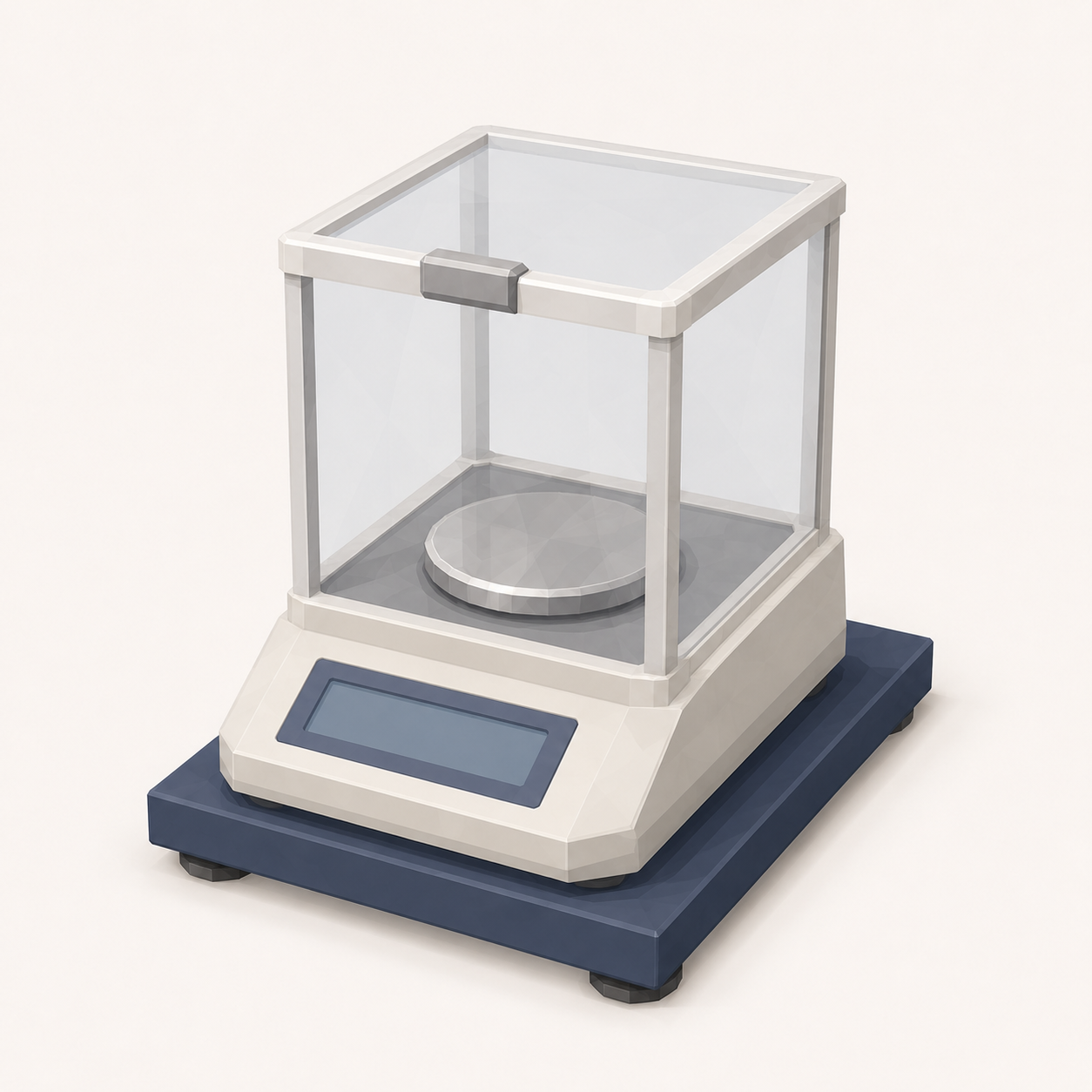
Almost every experiment starts with a measurement. There are five physical quantities you must be able to measure in the lab, each with an SI unit and its own apparatus.
| Quantity | SI unit | Common apparatus | Worth remembering |
|---|---|---|---|
| Time | second (s) | Digital stopwatch | A digital stopwatch reads to ±0.01 s. |
| Temperature | kelvin (K) | Thermometer (an alcohol thermometer typically covers about −10 °C to 110 °C) | Convert with K = °C + 273. A kelvin temperature can never be negative. |
| Length | metre (m) | Metre rule | Reads to ±0.1 cm (1 mm). |
| Mass | kilogram (kg) | Electronic balance | Reads to ±0.01 g. |
| Volume | cubic metre (m³) | Pipette, volumetric flask, measuring cylinder, burette, gas syringe | In the lab we usually work in cm³ and dm³ — see below. |
Choosing the right volume apparatus
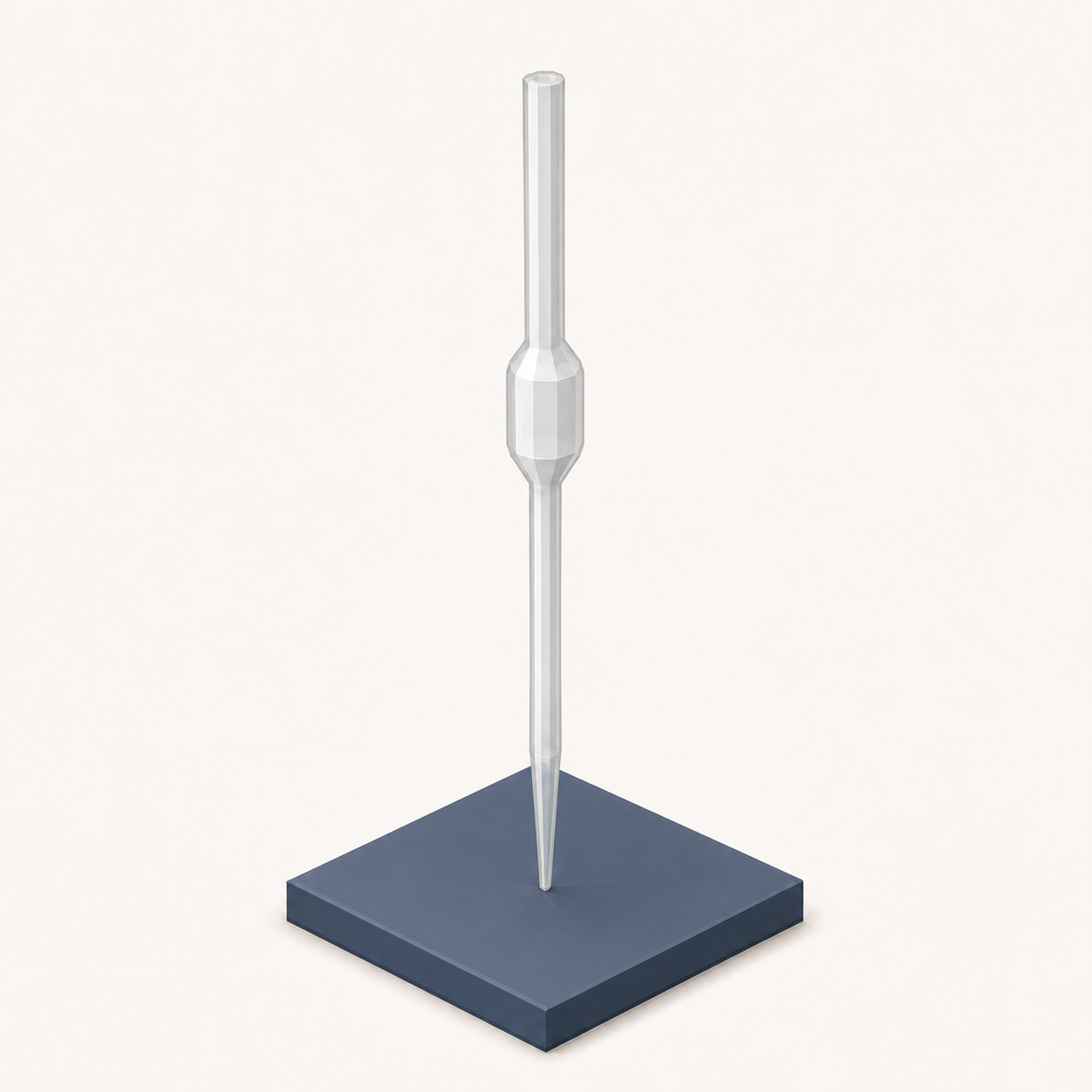
- Pipette — delivers one fixed volume very accurately, for example exactly 25.0 cm³. Used in titrations.
- Volumetric flask — holds one fixed, larger volume accurately (e.g. 250 cm³), used for making up standard solutions.
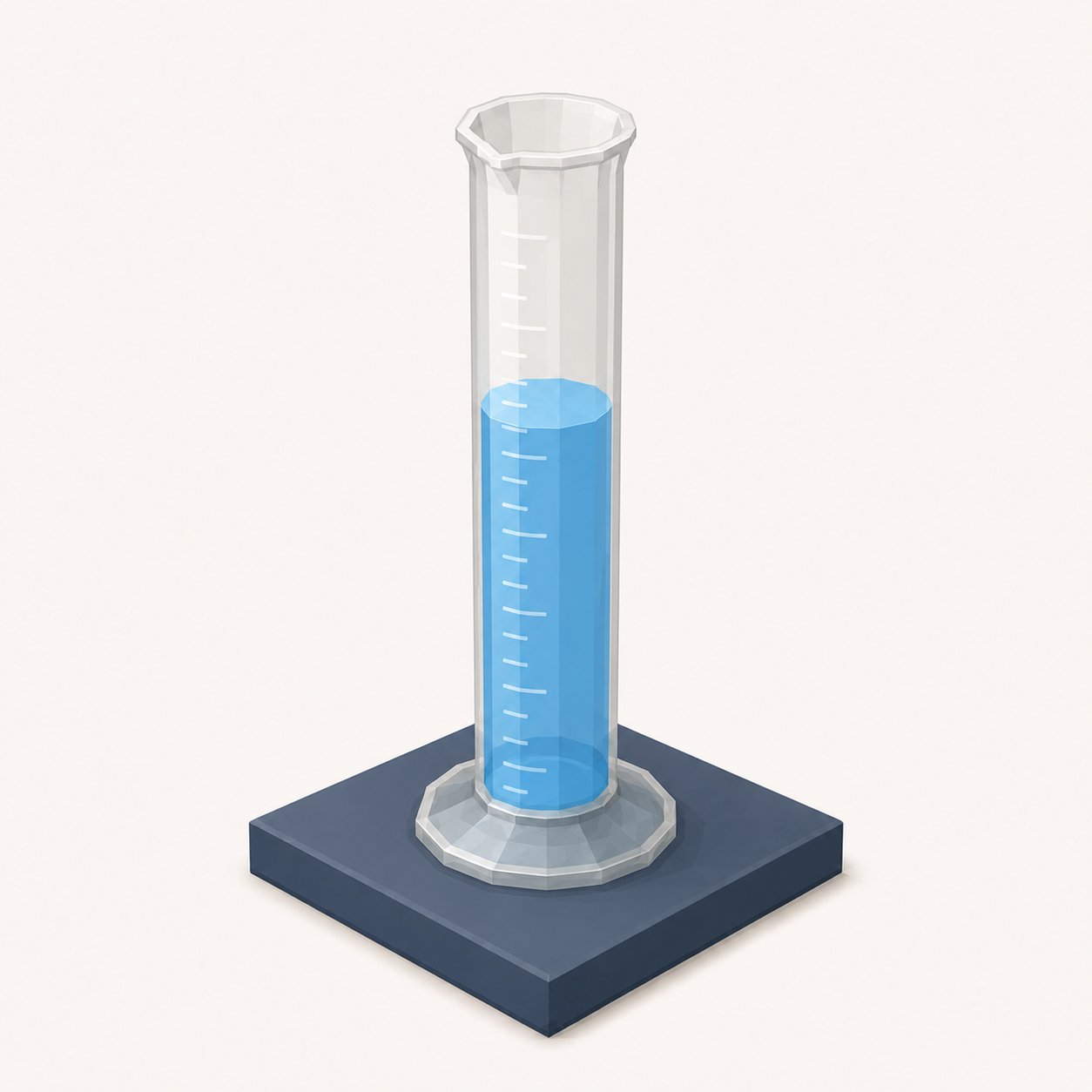
- Measuring cylinder — quick and flexible, but only reads to the nearest 0.5 cm³.
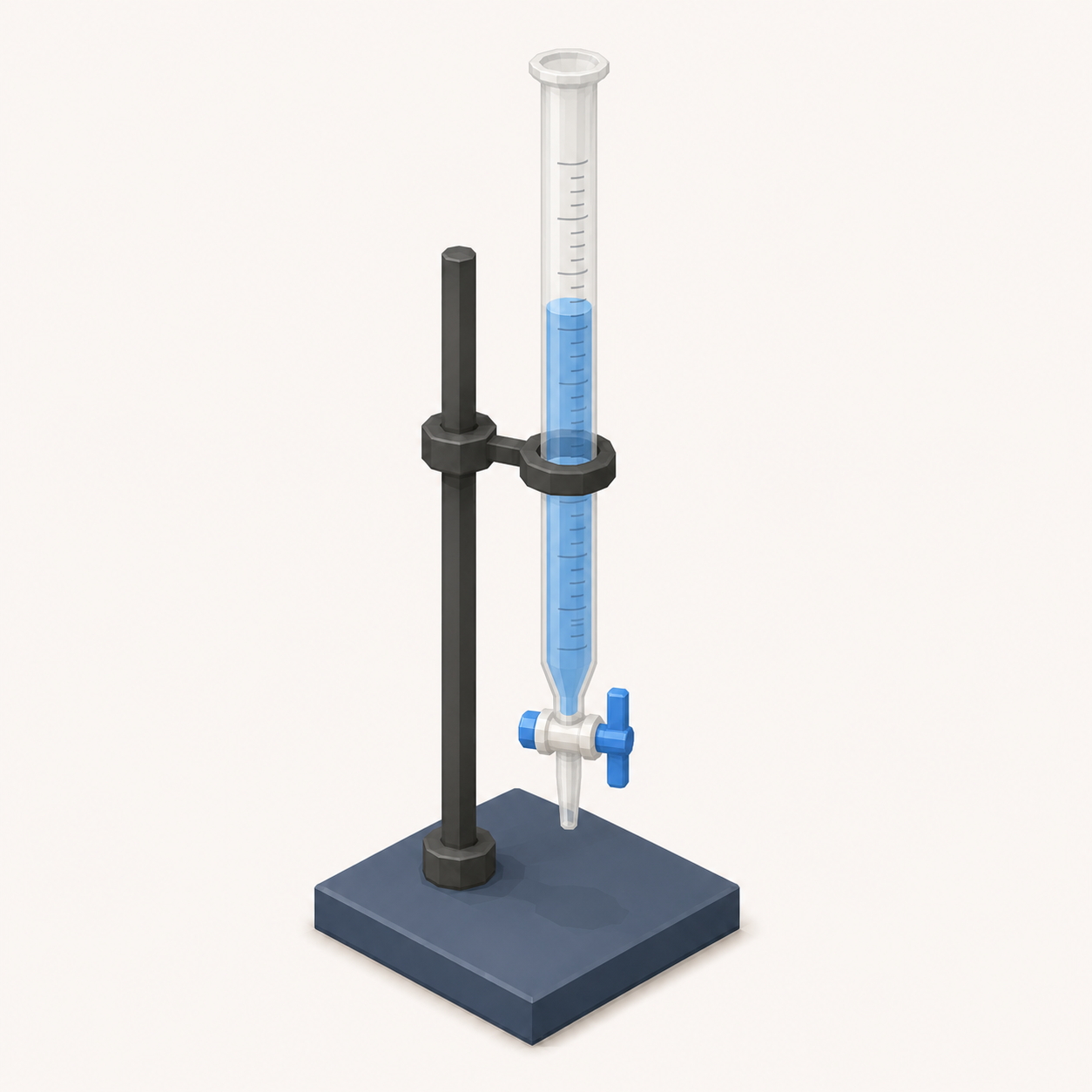
- Burette — delivers variable volumes and reads to the nearest 0.05 cm³, so it is the accurate choice when the volume is not fixed in advance.
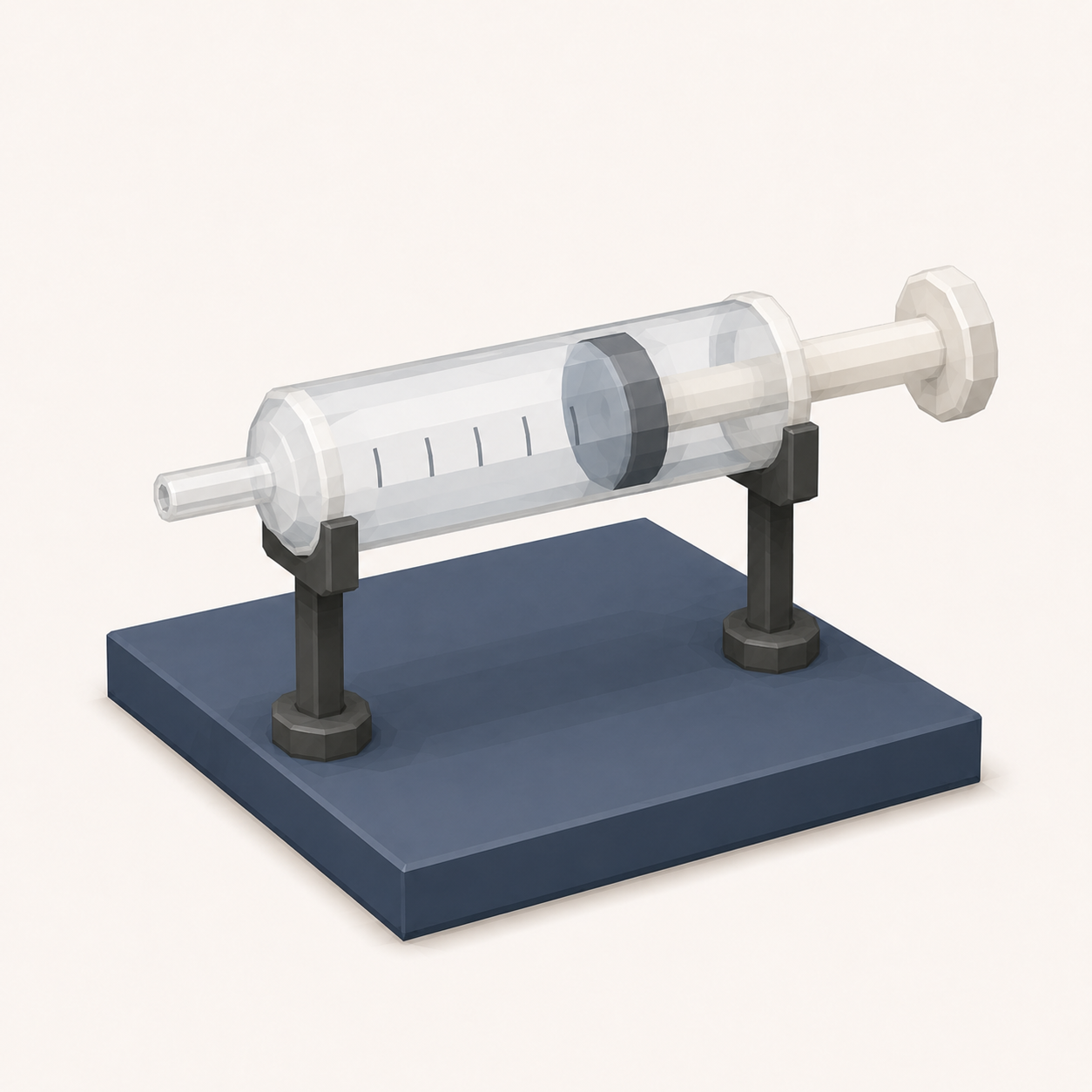
- Gas syringe — measures the volume of a gas.

Reading the meniscus
The curved surface of a liquid in a narrow tube is called the meniscus. Always read it with your eye level with the liquid surface to avoid parallax error. Water curves downwards (concave), so you read the bottom of the curve. Mercury bulges upwards (convex), so you read the top.
Past-paper questions
[G2 ScChem/2017/P3/Q2]MCQ
Which apparatus should the student use to measure these volumes?
- B. A burette accurately delivers the variable volume 13.2 cm3; a 25.0 cm3 volumetric pipette measures the fixed alkali volume.
[G2 ScChem/2023/P3/Q1]MCQ
Which apparatus is used to obtain the most accurate result?
- D. A pipette measures the fixed 25.0 cm3 volume accurately. A calibrated gas syringe measures the volume of gas collected.
[G2 ScChem/2023/P3/Q1]Open-ended · adapted
Open-response adaptation: answer the cited question in words and justify your answer.
A student prepares and measures the volume of carbon dioxide gas produced when 0.5 g of magnesium carbonate reacts with 25.0 cm3 of dilute hydrochloric acid.Which apparatus is used to obtain the most accurate result?
State the correct response in full. Explain the chemistry or use the supplied data to support it; an option letter alone is not sufficient.
Correct response: To measure hydrochloric acid: pipette; to collect carbon dioxide gas: gas syringe
A pipette measures the fixed 25.0 cm3 volume accurately. A calibrated gas syringe measures the volume of gas collected.
[G2 ScChem/2024/P3/Q2]MCQ
Which other pieces of apparatus are needed to find the volume of gas produced in 5 minutes?
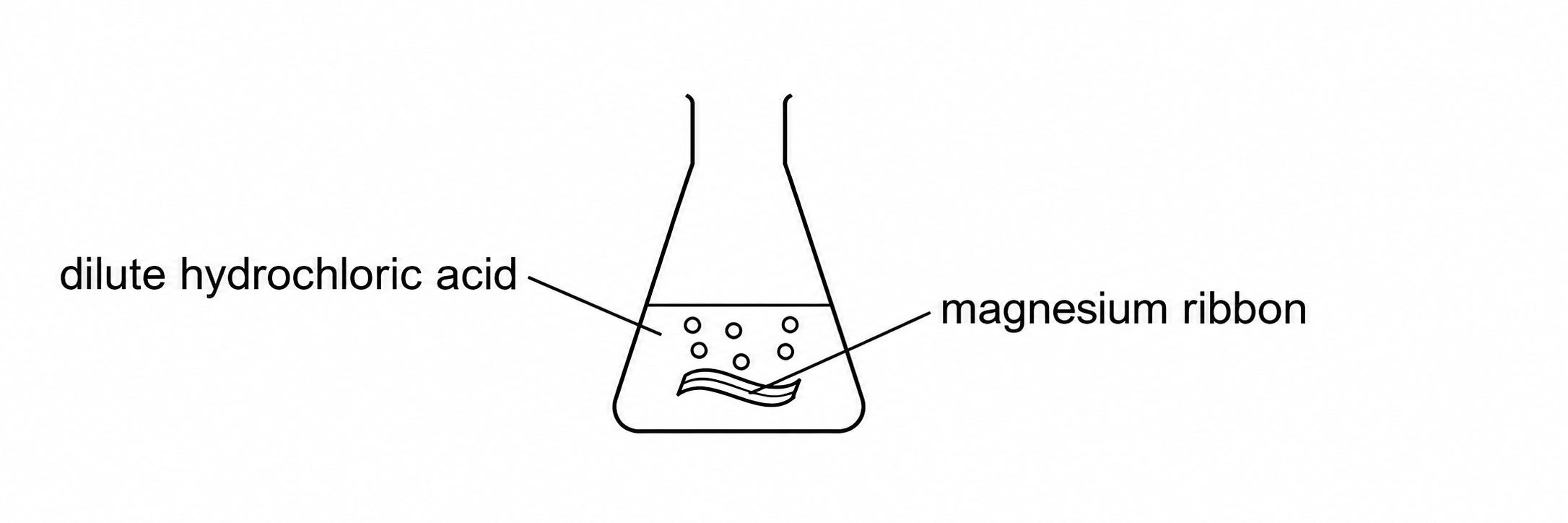
- B. A gas syringe collects and measures the hydrogen produced. A stop-watch measures the five-minute interval.
[G3 ScChem/2016/P3/Q1(a)]Open-ended
Name the pieces of apparatus most suitable to complete the following laboratory actions:
- separate a precipitate from a solution,
- measure exactly 22.7 cm3 of solution into a beaker,
- collect and measure the volume of a water-soluble gas,
- add exactly 25 cm3 of solution to each of several beakers.
- A filter funnel with filter paper.
- A burette.
- A graduated gas syringe.
- A 25 cm3 volumetric pipette.
The burette delivers an accurately measured variable volume; the volumetric pipette repeatedly delivers the same fixed volume.
[G3 ScChem/2019/P1/Q1]MCQ
A student carried out an experiment to study the rate of reaction when a piece of magnesium was added to some dilute hydrochloric acid.
Which piece of apparatus is not required for this experiment?
D. The reaction can be followed by measuring the volume of hydrogen collected over time. Heating is not required.
[G3 ScChem/2021/P1/Q1]MCQ
Which pieces of apparatus must be used to carry out an experiment to measure the change in temperature when 1 g of magnesium powder is added to excess dilute hydrochloric acid?
- a balance
- a gas syringe
- a stopwatch
- a thermometer
B. A balance measures the mass of magnesium and a thermometer measures the initial and final temperatures.
[G3 ScChem/2023/P1/Q1]MCQ
A titration is carried out to measure the volume of hydrochloric acid needed to neutralise aqueous sodium hydroxide.
Exactly 25 cm3 of aqueous sodium hydroxide is measured out into a conical flask and the hydrochloric acid is added.
Which apparatus is used during this experiment? Each option gives the apparatus for aqueous sodium hydroxide, then hydrochloric acid.
C. A volumetric pipette delivers the fixed 25 cm3 aliquot accurately. A burette measures the variable volume of acid needed.
[G3 Pure/2021/P1/Q1]MCQ
A student follows the rate of the reaction when 0.19 g of magnesium reacts with excess acid at room temperature and pressure.
What is most suitable for measuring the volume of gas produced at different times during this experiment?
B. Mg produces the same amount in moles of H2: 0.19/24 ≈ 0.0079 mol. At r.t.p. this occupies about 190 cm3, exceeding either 50 cm3 option. Hydrogen can be collected over water in the 250 cm3 cylinder.
[G3 Pure/2022/P1/Q1]MCQ
A student investigates the rate of reaction between a solid and a liquid. During the reaction, the student measures the volume of gas released.
The student is provided with a conical flask, a pipette and a balance.
Which additional apparatus is needed?
- stopwatch
- gas syringe
- thermometer
A. A stopwatch measures elapsed time and a gas syringe measures gas volume. A thermometer is not needed for the stated measurements.
Collecting and drying gases
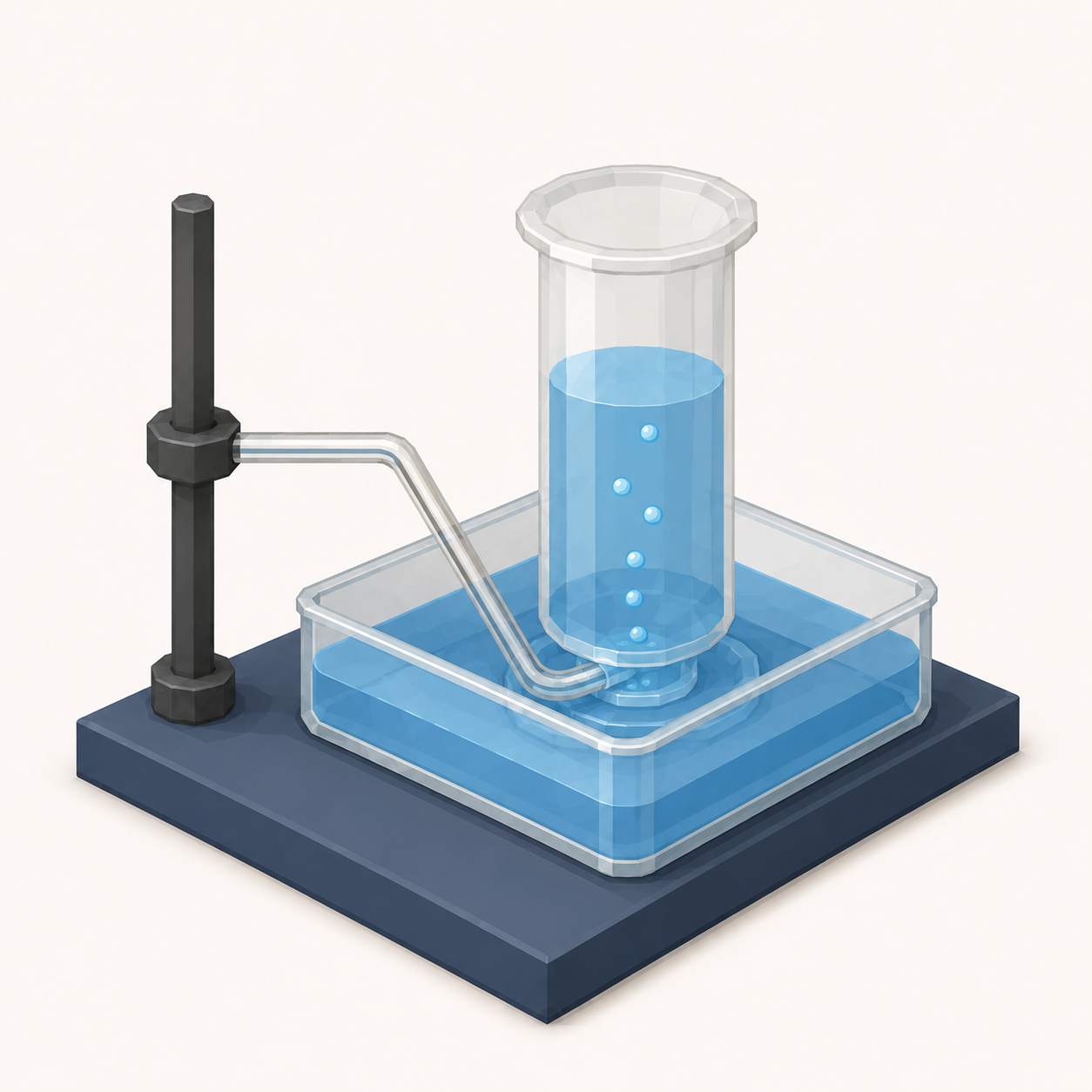
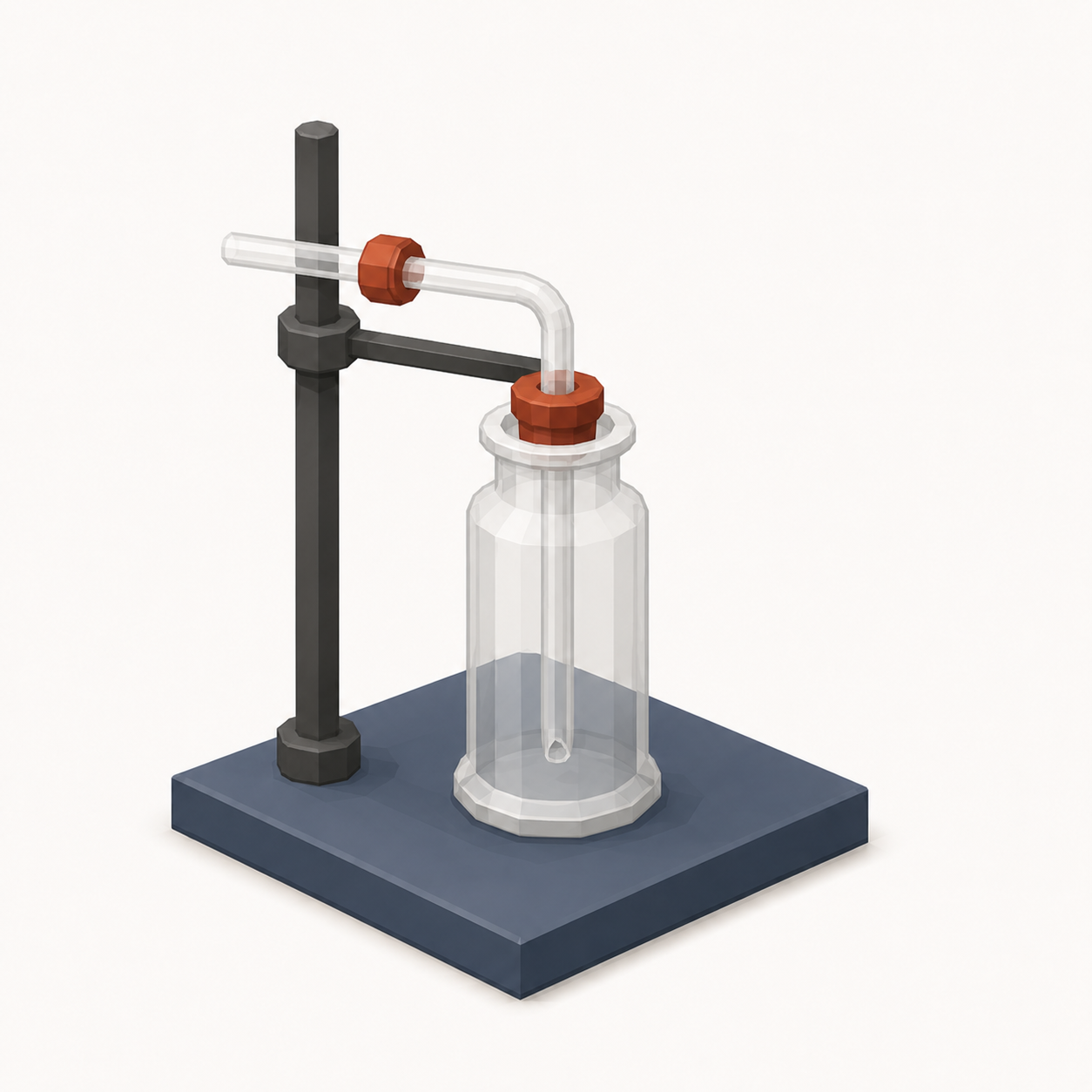
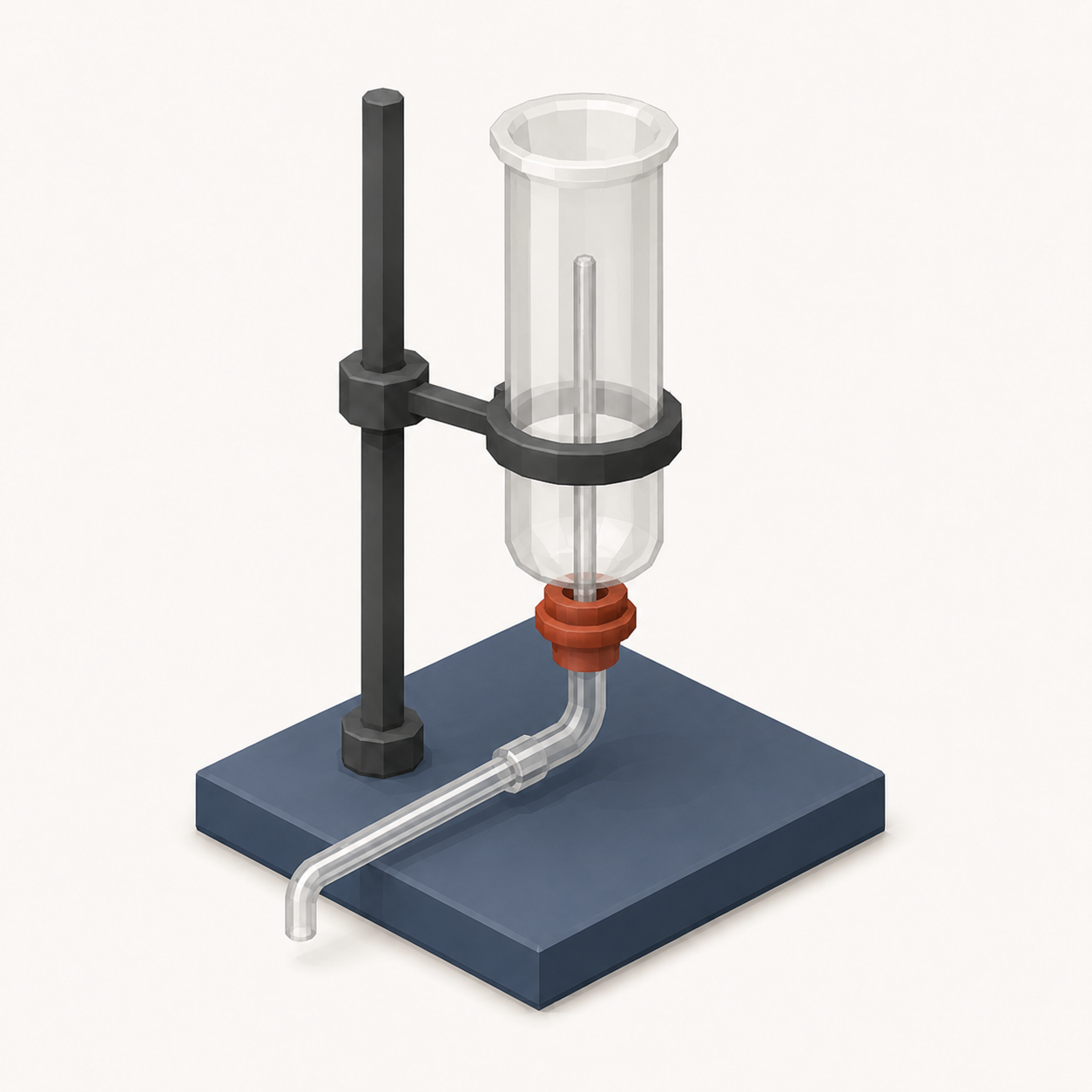
How you collect a gas depends on two properties: how soluble it is in water, and whether it is denser or less dense than air.
| Collection method | Use when the gas is… | Examples |
|---|---|---|
| Displacement of water | insoluble, or only slightly soluble, in water | hydrogen, oxygen, carbon dioxide |
| Downward delivery | denser than air (the gas sinks and fills the jar from the bottom) | chlorine, hydrogen chloride, sulfur dioxide |
| Upward delivery | less dense than air (the gas rises into an upside-down jar) | ammonia |
| Gas syringe | you need an accurate volume of the gas | any gas whose volume must be measured |
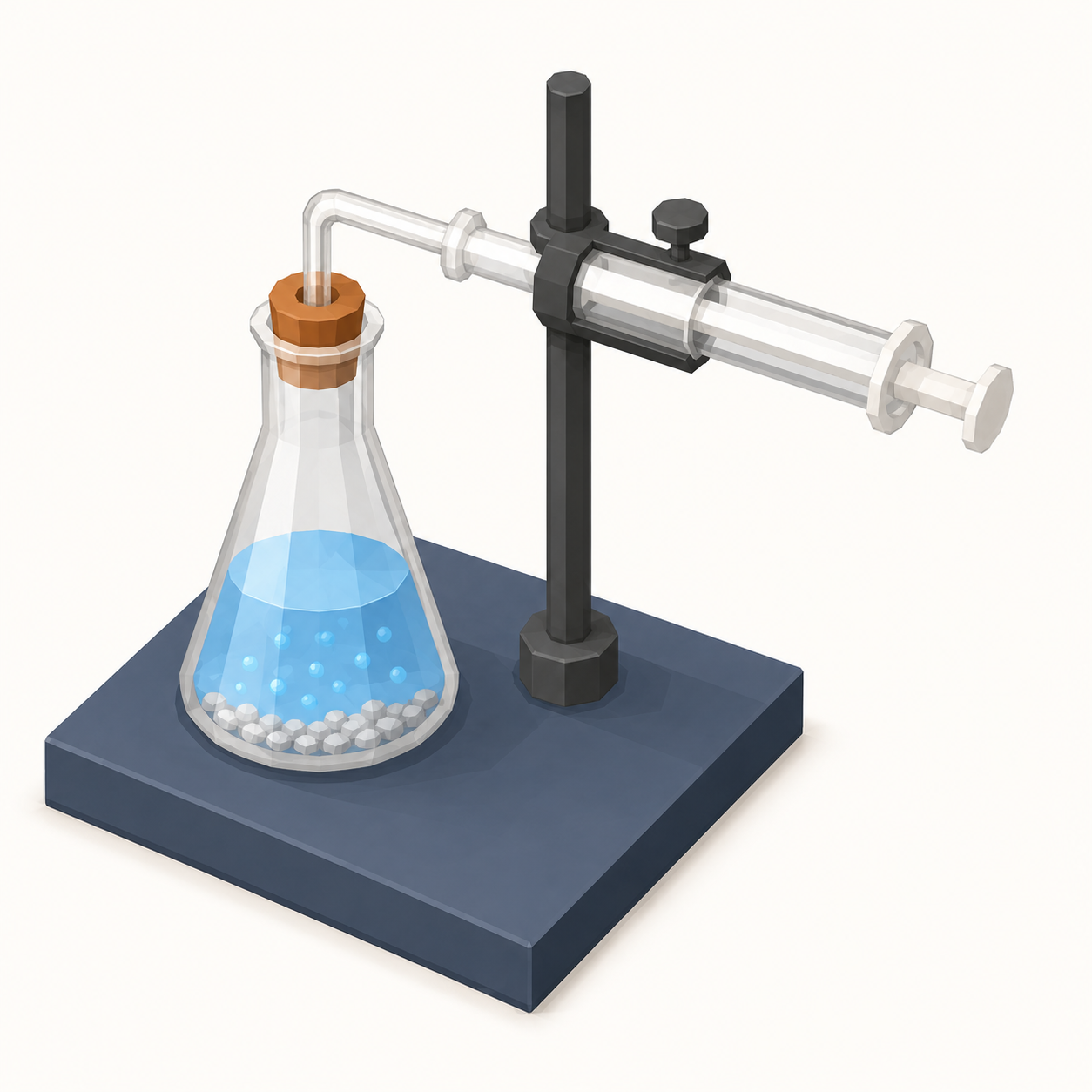
Drying a gas Optional for G3/G2 ScChem
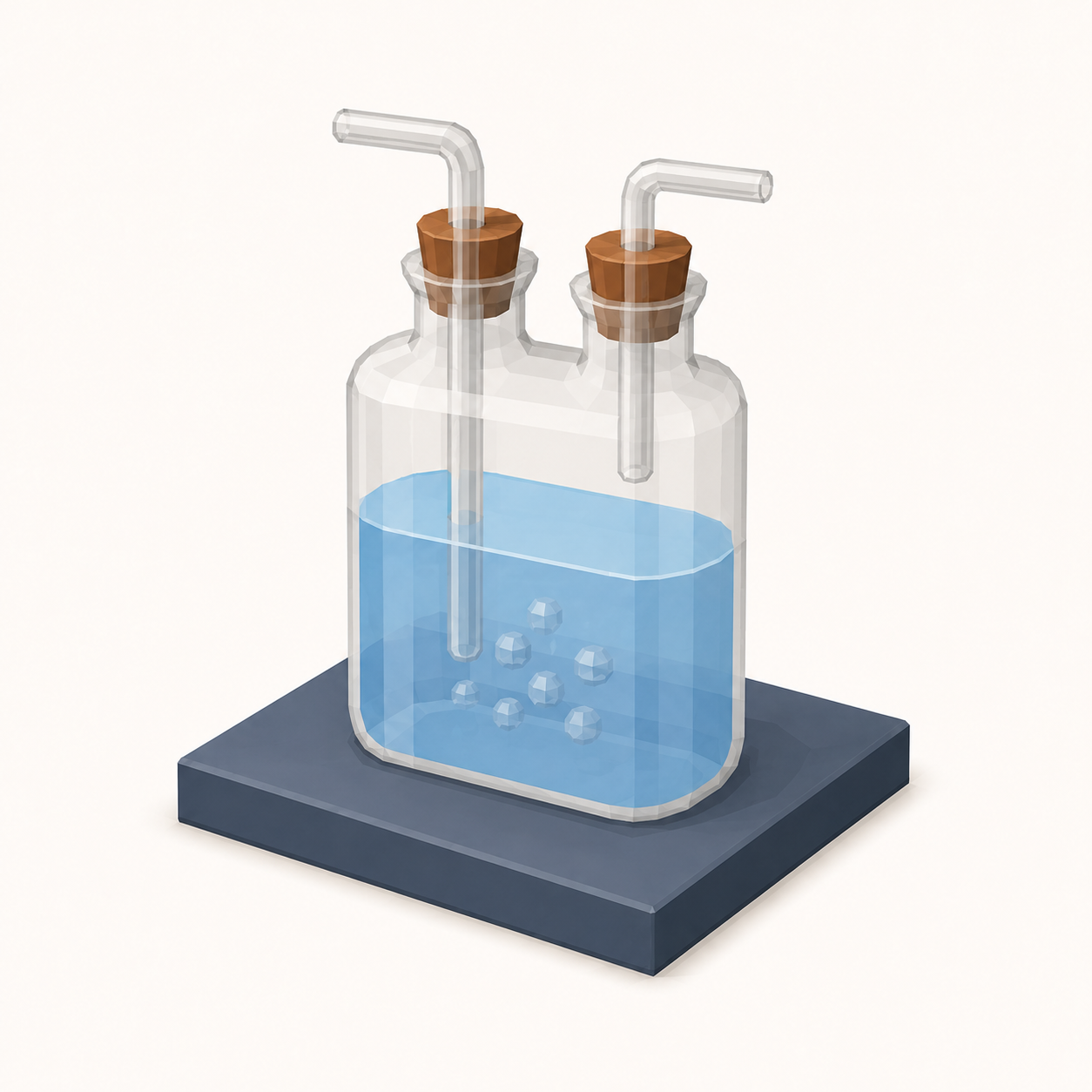
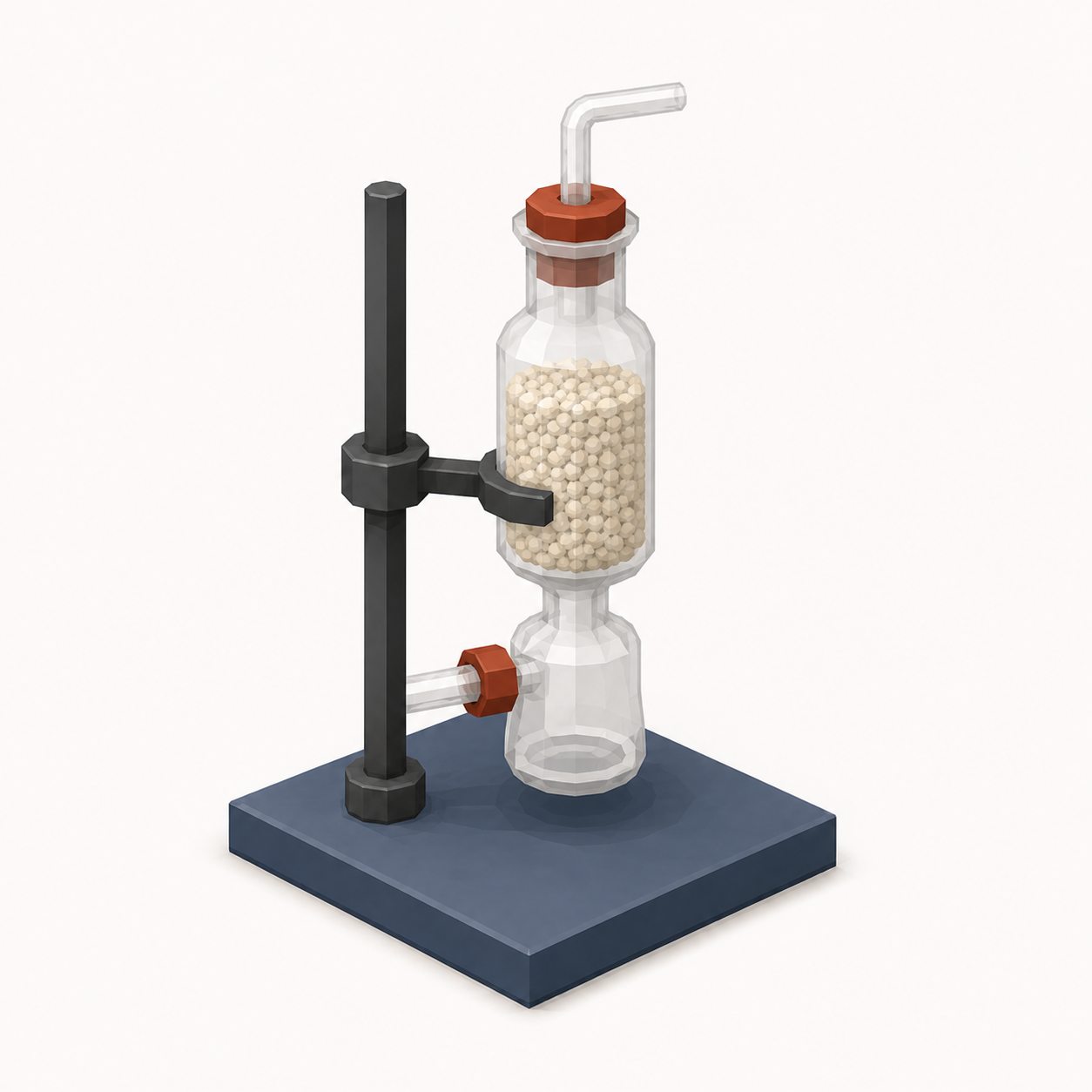
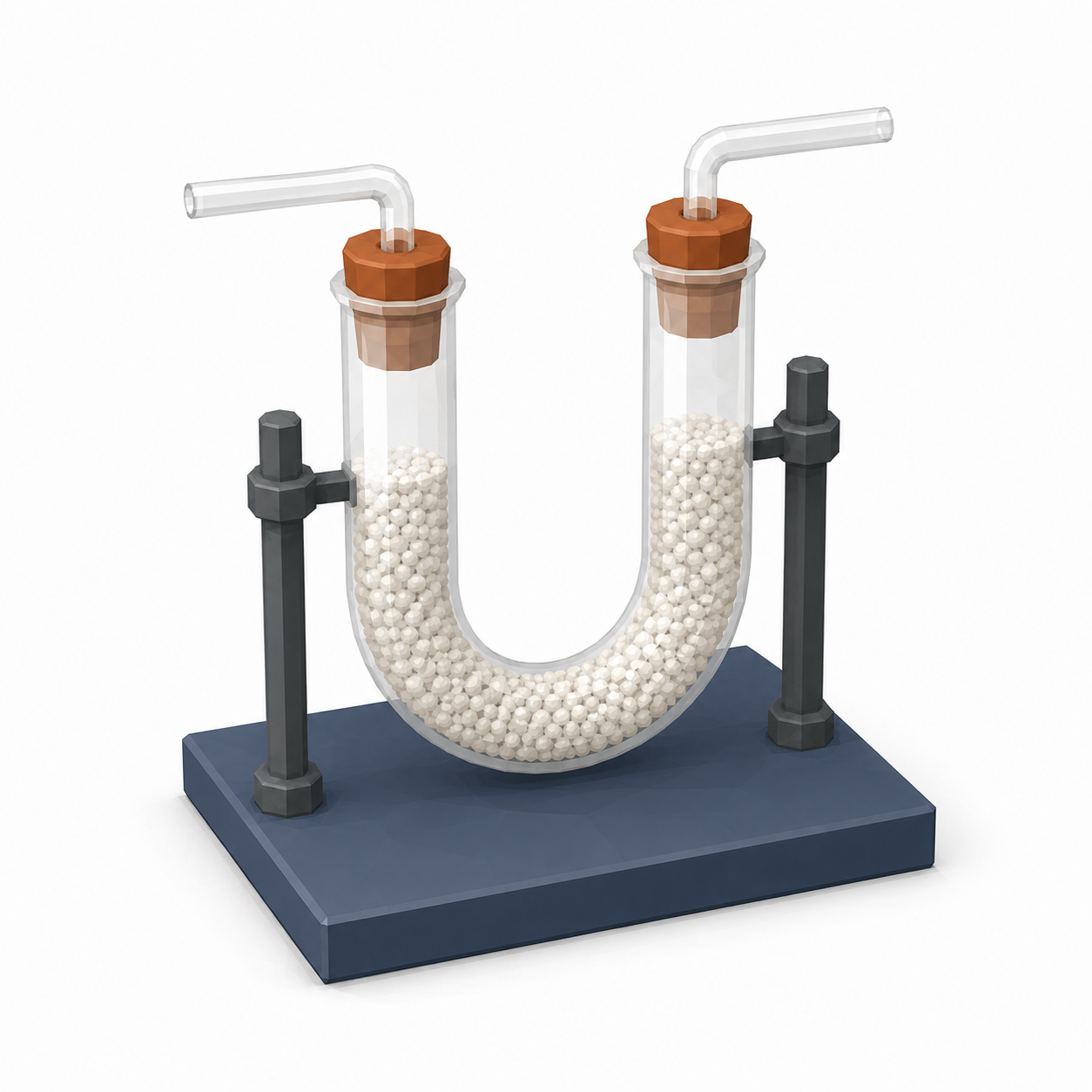
A collected gas is often damp. Pass it through (or over) a drying agent — but pick one that does not react with the gas itself:
| Drying agent | Good for | Never use with |
|---|---|---|
| Concentrated sulfuric acid | most gases | ammonia (an alkaline gas — it reacts with the acid) |
| Quicklime (calcium oxide) | ammonia | carbon dioxide (an acidic gas — it reacts with the basic quicklime) |
| Fused calcium chloride | hydrogen, nitrogen, carbon dioxide | ammonia (it combines with the calcium chloride) |
Past-paper questions
[G2 ScChem/2020/P4A/Q3(e)]Open-ended
State the apparatus that could be used to collect and measure the volume of oxygen gas.
Use a gas syringe. An inverted measuring cylinder filled with water is also acceptable because oxygen is only slightly soluble in water.
[G2 ScChem/2020/P4A/Q3(e)]Open-ended · adapted
Open-response extension: build on the cited structured-response item.
State the apparatus that could be used to collect and measure the volume of oxygen gas.
After answering, add one chemical reason, observation or consequence that supports your response.
Use a gas syringe. An inverted measuring cylinder filled with water is also acceptable because oxygen is only slightly soluble in water.
The additional point must be chemically consistent and explicitly connected to the answer.
[G3 ScChem/2018/P1/Q1]MCQ
The diagrams show two methods of collecting gases.
Which row gives the properties of a gas that can be collected by both methods? Each option gives property 1, then property 2.
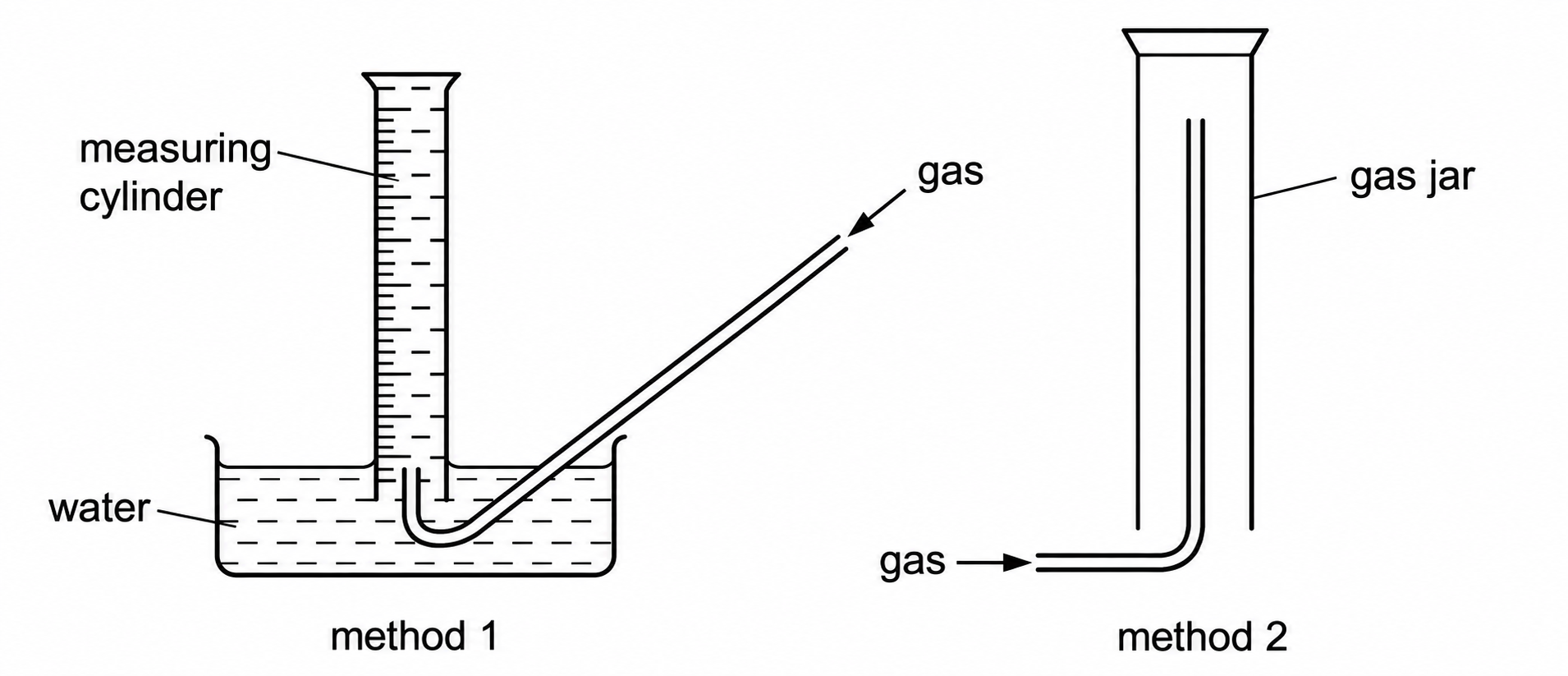
B. Collection over water requires a gas that is insoluble or only slightly soluble in water. The inverted gas jar in method 2 collects a gas less dense than air by upward delivery.
[G3 Pure/2017/P1/Q1]MCQ
A student is provided with two drying agents: concentrated sulfuric acid and calcium oxide.
Which method should he use to collect a sample of dry ammonia?
[Mr: NH3, 17]
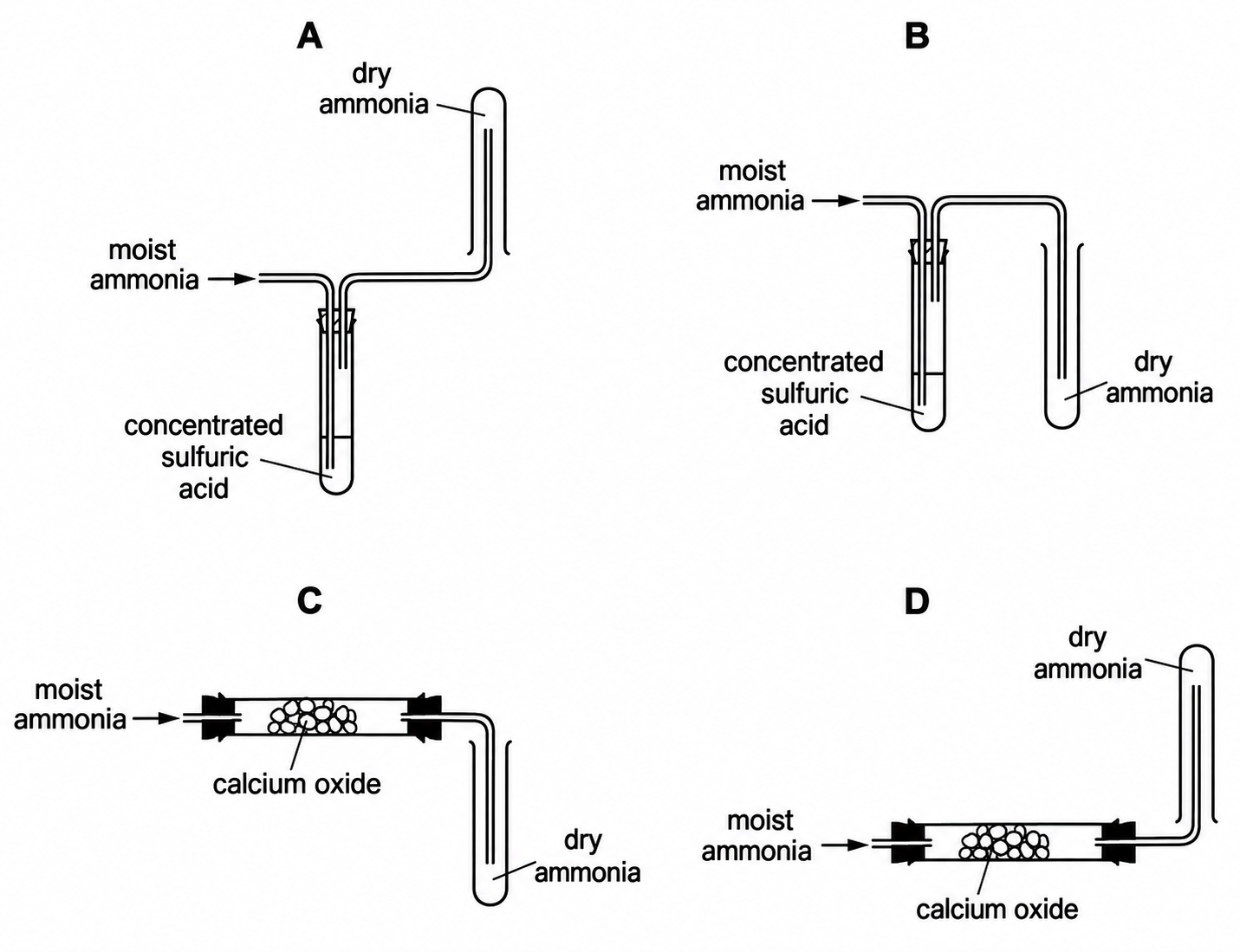
D. Calcium oxide dries ammonia without reacting with it. Concentrated sulfuric acid reacts with ammonia. Ammonia is less dense than air, so collect it by upward delivery in an inverted tube.
Choosing a separation technique
A mixture can be separated because each component keeps its own physical properties — particle size, solubility, density, boiling or melting point, magnetism. Every technique below simply exploits one property that the components do not share.
| Technique | Use when… |
|---|---|
| Solid + solid | |
| Magnetic attraction | one solid is magnetic (iron, cobalt or nickel) and the other is not. |
| Sieving | the solids have clearly different particle sizes. |
| Using a suitable solvent | one solid dissolves in a chosen solvent and the other does not. |
| Sublimation Optional for G3/G2 ScChem | one solid sublimes (turns straight to gas) on warming and the other does not. |
| Solid + liquid | |
| Filtration | the solid is insoluble — it gets trapped by the filter paper. |
| Evaporation to dryness | you want a dissolved solid back and it is heat-stable. |
| Crystallisation | the dissolved solid would decompose if boiled dry. |
| Simple distillation | you want to keep the liquid (solvent) as well. |
| Liquid + liquid | |
| Separating funnel Optional for G3/G2 ScChem | the liquids are immiscible (form separate layers). |
| Fractional distillation | the liquids are miscible but have different boiling points. |
| Chromatography | you want to identify small amounts of dissolved substances. |
Past-paper questions
[G2 ScChem/2018/P3/Q4]MCQ
Mixture 2 contains salt and water.
Which method of separation could be used to obtain each of the required products from each mixture?
- D. Filtration separates insoluble sand from water. Crystallisation recovers dissolved salt, while distillation collects the water from salt solution.
[G2 ScChem/2019/P3/Q2]MCQ
The table shows some of the properties of P, Q and R.
| Substance | State | Solubility in water | Solubility in ethanol |
|---|---|---|---|
| P | solid | yes | no |
| Q | liquid | no | yes |
| R | solid | no | no |
Which method describes how a pure sample of substance Q can be separated from the original mixture?
- A. Ethanol dissolves Q but neither P nor R. Filtering removes the insoluble solids. Distillation then separates the ethanol from Q.
[G2 ScChem/2024/P3/Q1]MCQ
Solid potassium nitrate decomposes when heated strongly.
How is solid potassium nitrate obtained from its aqueous solution?
- B. Concentrate the solution, allow it to cool so crystals form, then filter them off. Heating the solid strongly would cause decomposition.
[G3 ScChem/2020/P1/Q2]MCQ
Which method is used to obtain potassium chloride crystals from an aqueous solution of potassium chloride?
A. Evaporation removes the water and leaves the dissolved potassium chloride. Filtration cannot separate a dissolved solute from its solvent.
[G3 ScChem/2024/P3/Q2]Open-ended
Complete the Table with the method of separation used to produce a sample of each of the components in the named mixtures.
| Mixture | Method of separation |
|---|---|
| coloured inks | … |
| crude oil | … |
| salt and water | … |
| sand and water | … |
Coloured inks: paper chromatography. Crude oil: fractional distillation. Salt and water: simple distillation to collect water and retain salt, or crystallisation if only salt is required. Sand and water: filtration.
[G3 Pure/2021/P1/Q2]MCQ
The boiling points of some of the substances found in air are given in the table.
Air is cooled to −250 °C so that some of the substances in it condense.
As the temperature is raised, which substance will turn into a gas first?
B. Neon has the lowest boiling point, −246 °C, so it is reached first as the temperature rises from −250 °C.
[G3 Pure/2023/P1/Q1]MCQ
A student prepares a pure sample of sodium sulfate from dilute sulfuric acid and aqueous sodium hydroxide.
Which apparatus does the student use?
B. A burette and pipette are used to find the neutralising volumes by titration. An evaporating dish concentrates the sodium sulfate solution before crystallisation.
[G3 Pure/2024/P1/Q3]MCQ
A solid mixture contains magnesium sulfate, MgSO4, and sand.
Which sequence allows pure magnesium sulfate crystals to be separated from the solid mixture?
D. Dissolve the magnesium sulfate, filter off the insoluble sand, concentrate the filtrate to saturation and cool to form crystals.
[G3 Pure/2024/P1/Q3]Open-ended · adapted
Open-response adaptation: answer the cited question in words and justify your answer.
A solid mixture contains magnesium sulfate, MgSO4, and sand.
Which sequence allows pure magnesium sulfate crystals to be separated from the solid mixture?
State the correct response in full. Explain the chemistry or use the supplied data to support it; an option letter alone is not sufficient.
Correct response: add water → heat → filter → evaporate filtrate to saturation → cool to give crystals
Dissolve the magnesium sulfate, filter off the insoluble sand, concentrate the filtrate to saturation and cool to form crystals.
[G3 Pure/2024/P1/Q4]MCQ
Mixtures W, X, Y and Z need to be separated.
W is solid lead(II) chloride and lead(II) nitrate.
X is lubricating oil and water.
Y is ethanol and water.
Z is iodine and sand.
Possible methods for the separation of mixtures are listed.
- sublimation
- using a separating funnel
- adding water, followed by filtration
- fractional distillation
Which row shows a suitable method for separating mixtures W, X, Y and Z? Each option lists the mixtures for methods 1, 2, 3 and 4 respectively.
D. Iodine sublimes from sand; oil and water are immiscible; lead(II) nitrate dissolves in cold water while lead(II) chloride remains for filtration; ethanol and water separate by fractional distillation.
Separating solid–solid mixtures
Magnetic attraction
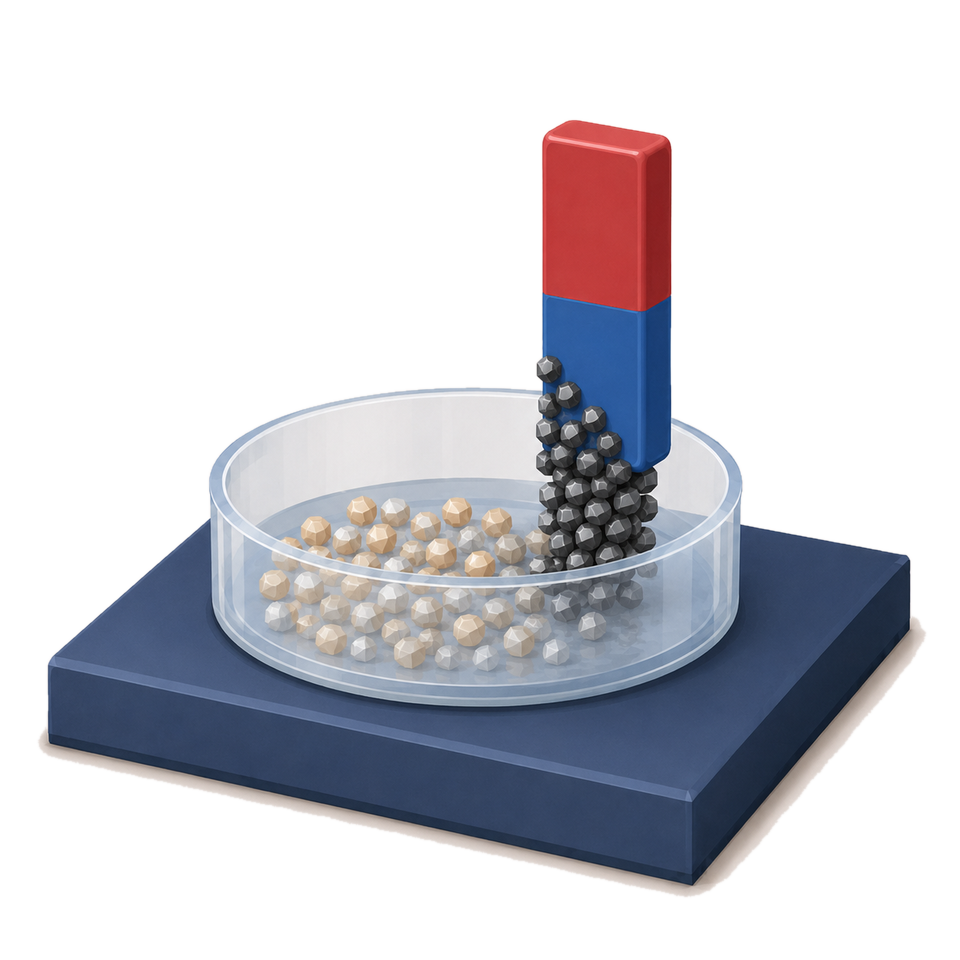
Iron, cobalt and nickel — and alloys containing them, such as steel — are attracted to a magnet, so a magnet can pull the magnetic solid cleanly out of a mixture. Recycling plants use giant electromagnets to lift steel and iron out of mixed scrap.
Sieving
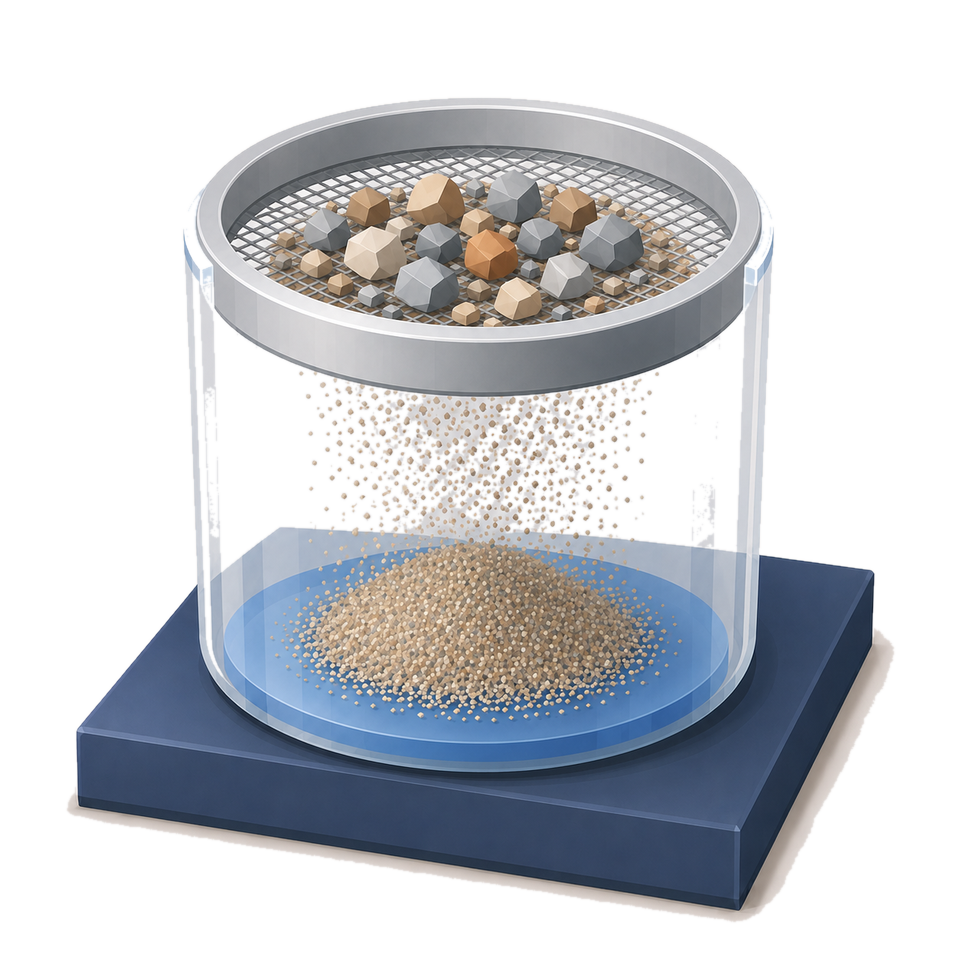
A sieve separates solids by particle size: small particles fall through the mesh, large ones stay behind. Bakers sieve flour to remove lumps, and archaeologists sieve soil so that tiny artefacts are caught while the fine earth passes through.
Using a suitable solvent
If one solid dissolves in a solvent and the other does not, add the solvent, stir, then filter. Classic example: salt mixed with sand. Water dissolves the salt but not the sand, so filtering removes the sand and evaporating or crystallising the salty filtrate gives back the salt.
Sublimation Optional for G3/G2 ScChem
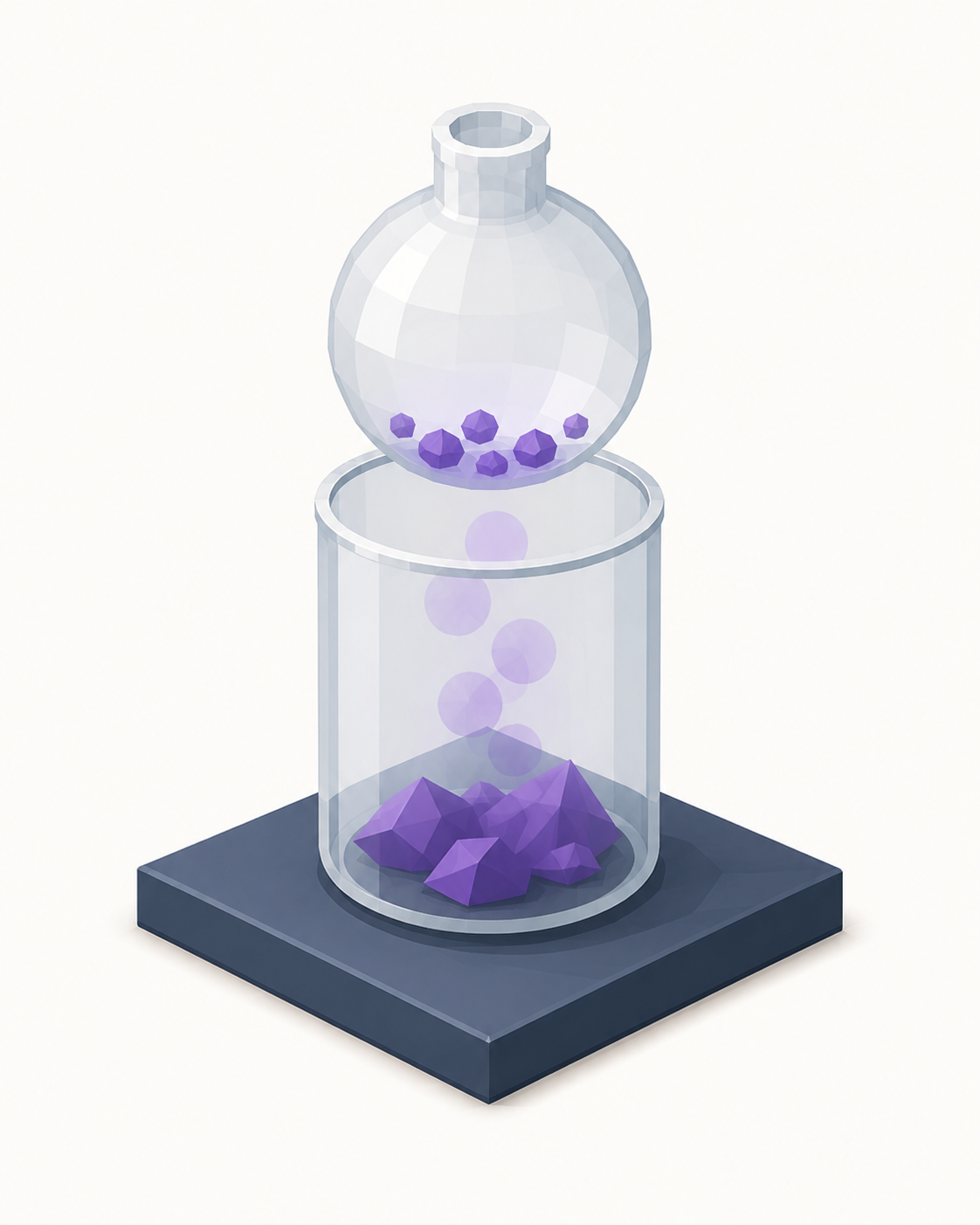
Sublimation is when a solid changes directly into a gas without melting first (and the gas turns straight back into a solid when cooled). Only a few substances do this — iodine, naphthalene (mothballs) and dry ice (solid carbon dioxide) are the ones to remember.
To separate, warm the mixture gently: the subliming solid rises as a vapour, hits a cool surface (such as a cold flask held above), and re-forms as a solid there, called the sublimate. The other solid stays in the container. Try it in the sublimation lab →
Separating solid–liquid mixtures
Filtration — for insoluble solids
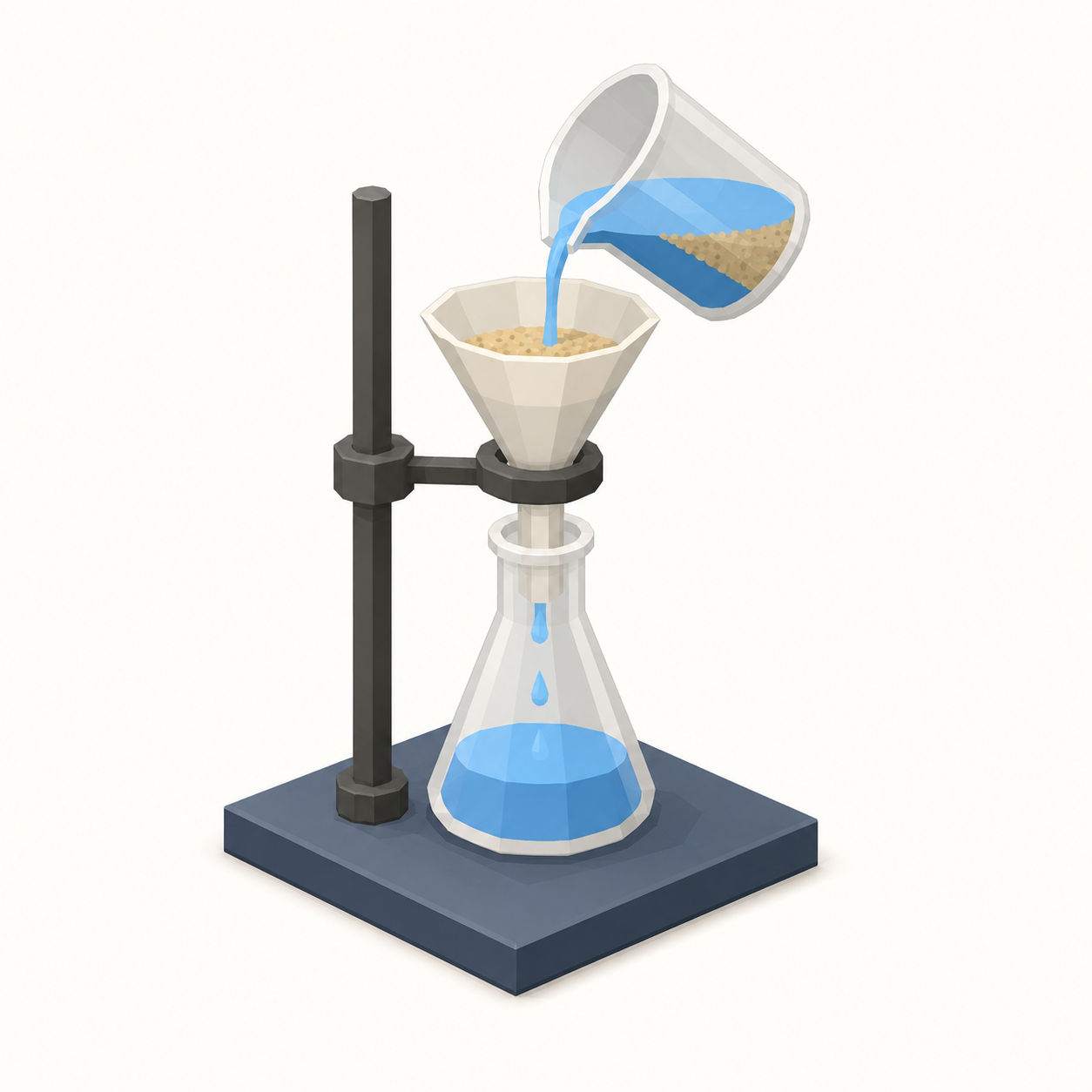
Pour the mixture through filter paper folded into a cone inside a funnel. The paper acts like an extremely fine sieve: liquid passes through its tiny pores while insoluble solid particles are too large and get trapped.
- The solid left on the paper is the residue.
- The liquid that passes through is the filtrate.
Try it in the filtration lab →
Evaporation to dryness — for dissolved solids
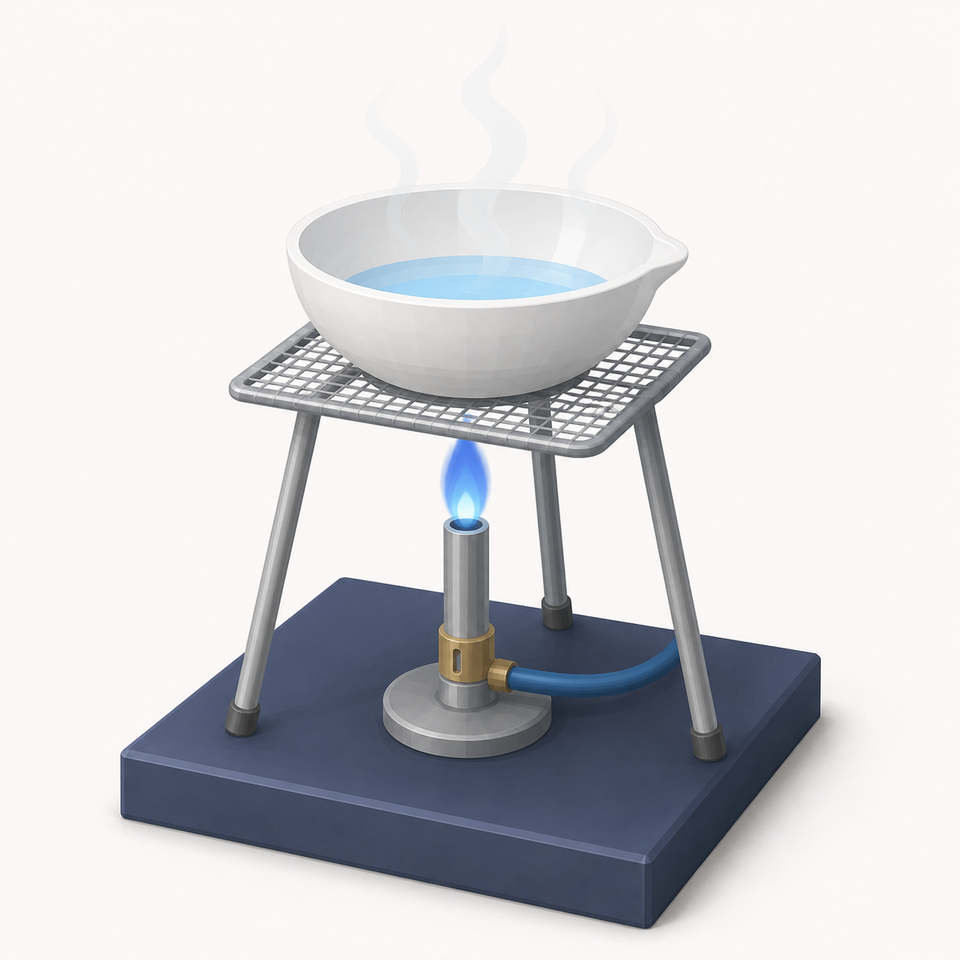
Heat the solution in an evaporating dish until all of the solvent has boiled away, leaving the solid behind. It is fast, but it has two limitations:
- Some solids decompose when heated strongly — sugar, for example, chars into a black mess instead of coming back as crystals.
- Everything dissolved comes out together, so the solid you get may actually be a mixture of several salts, not one pure substance.
Crystallisation — the gentler option
Because heat-sensitive solids survive gentle treatment, crystallisation is used when evaporation to dryness would destroy the product:
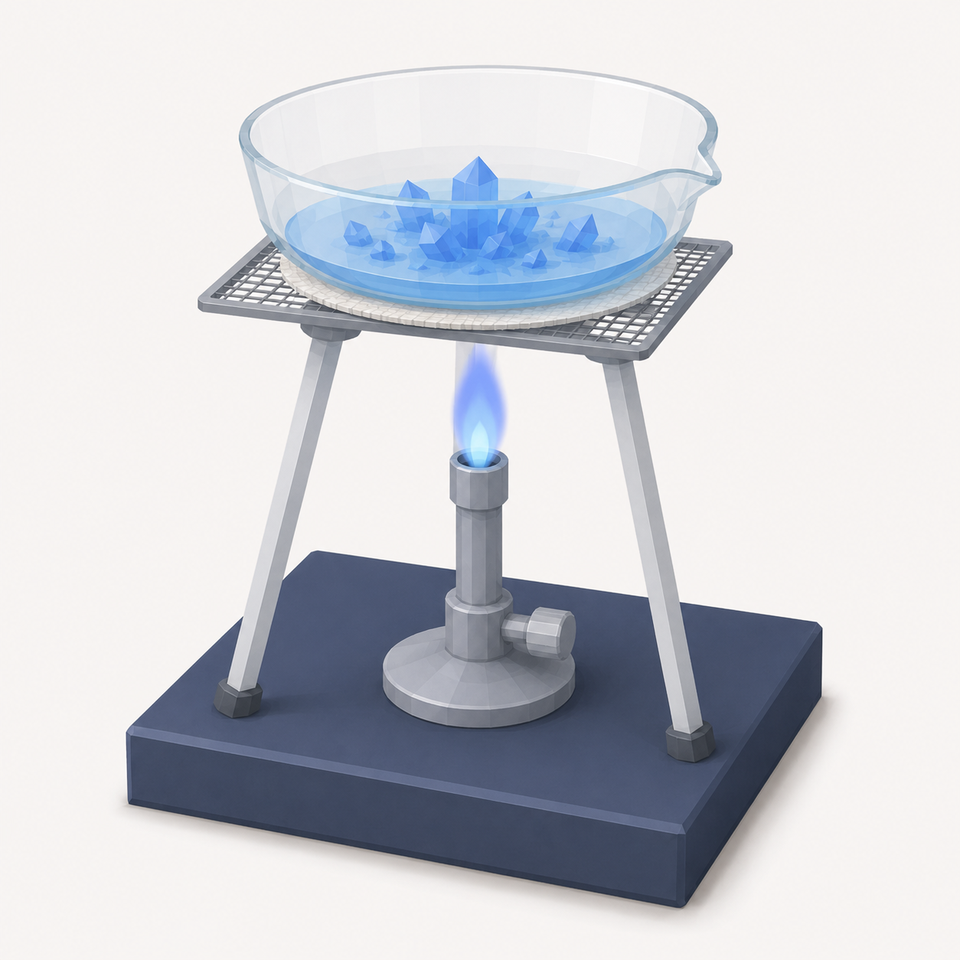
- Heat the solution gently to evaporate some solvent and concentrate it until it is just saturated.
- Let it cool slowly — as the temperature drops, the solvent can hold less solute, so the excess comes out as crystals.
- Filter to collect the crystals.
- Wash them with a little cold solvent and dry them between sheets of filter paper.
Simple distillation — when you want the liquid too
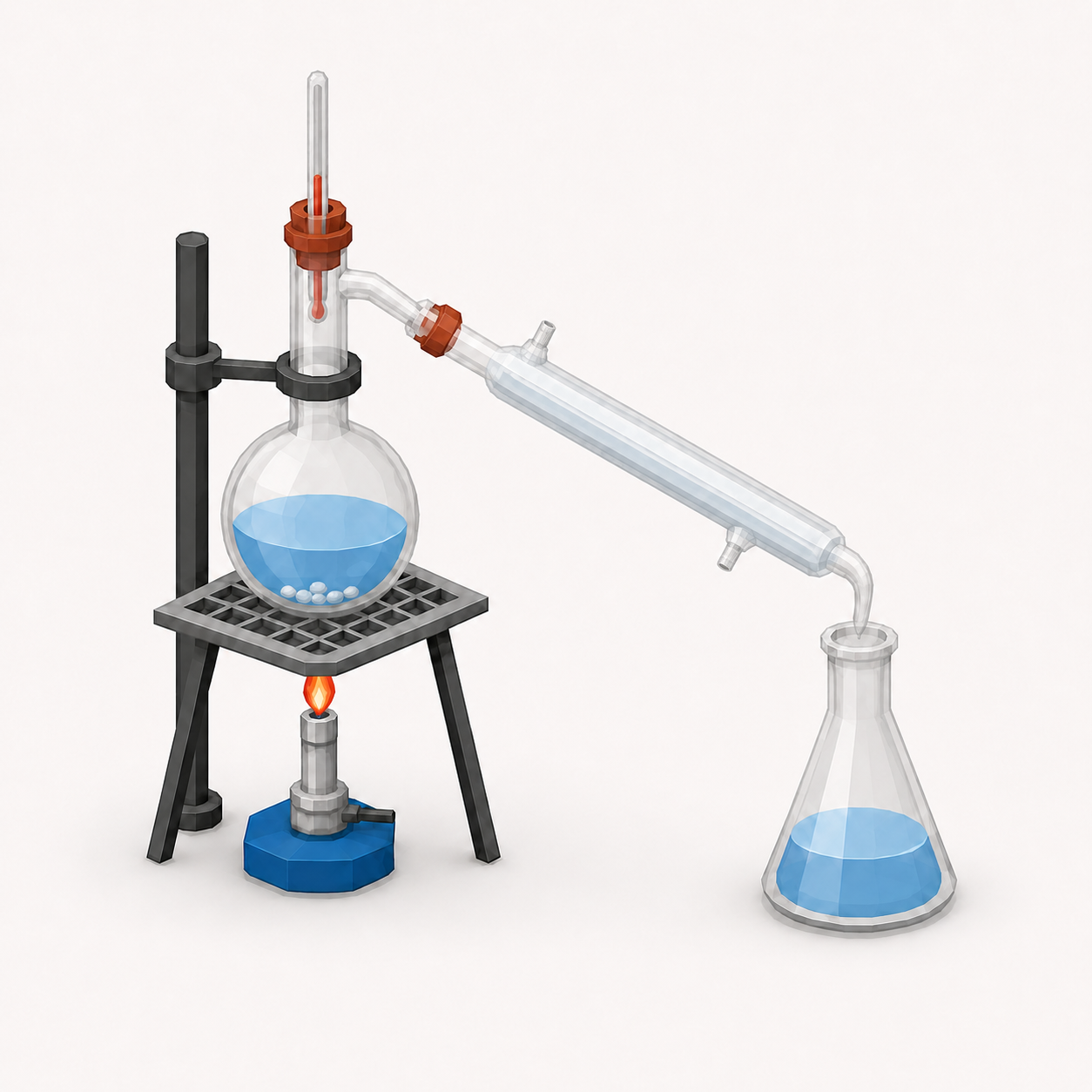
Evaporation and crystallisation throw the solvent away as vapour. If you want to keep both parts — say, drinking water from sea water — use simple distillation. The solution is boiled; the solvent vapour travels into a cooled condenser where it turns back into liquid, called the distillate, and drips into a receiver. The dissolved solute stays behind in the flask because its boiling point is far higher. Try it in the distillation lab →
Add a few boiling chips (anti-bumping granules) before heating. Their rough surfaces provide nucleation sites where bubbles can form, so the liquid boils smoothly without bumping or splashing. Never add them to an already hot liquid because this can cause sudden vigorous boiling.
Which one should I pick?
| Evaporation to dryness | Crystallisation | Simple distillation | |
|---|---|---|---|
| What you keep | the solid only | the solid only (as clean crystals) | the solvent (distillate) and the solute |
| Heating | strong — boil everything away | gentle — concentrate, then cool | boil, but the solvent is recovered |
| Best when | the solid is heat-stable | the solid decomposes on strong heating | the solvent is valuable too |
Separating liquid–liquid mixtures
Immiscible liquids — separating funnel Optional for G3/G2 ScChem
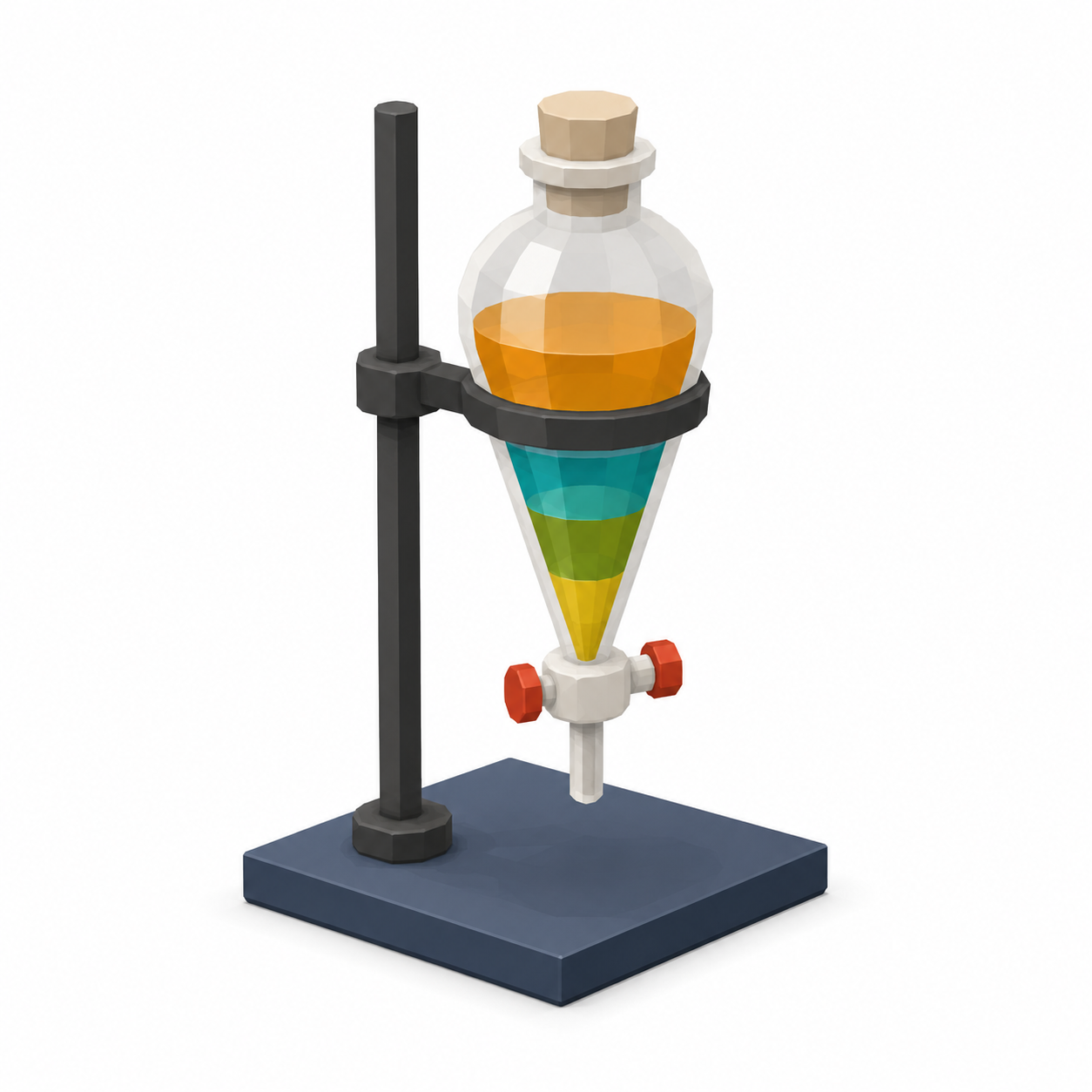
Immiscible liquids, like oil and water, do not mix — they settle into layers, with the denser liquid at the bottom. Pour the mixture into a separating funnel, let the layers settle, then open the tap: the bottom layer runs out into a beaker. Close the tap the moment the boundary reaches it, and the two liquids are apart. Try it in the separating-funnel lab →
Miscible liquids — fractional distillation
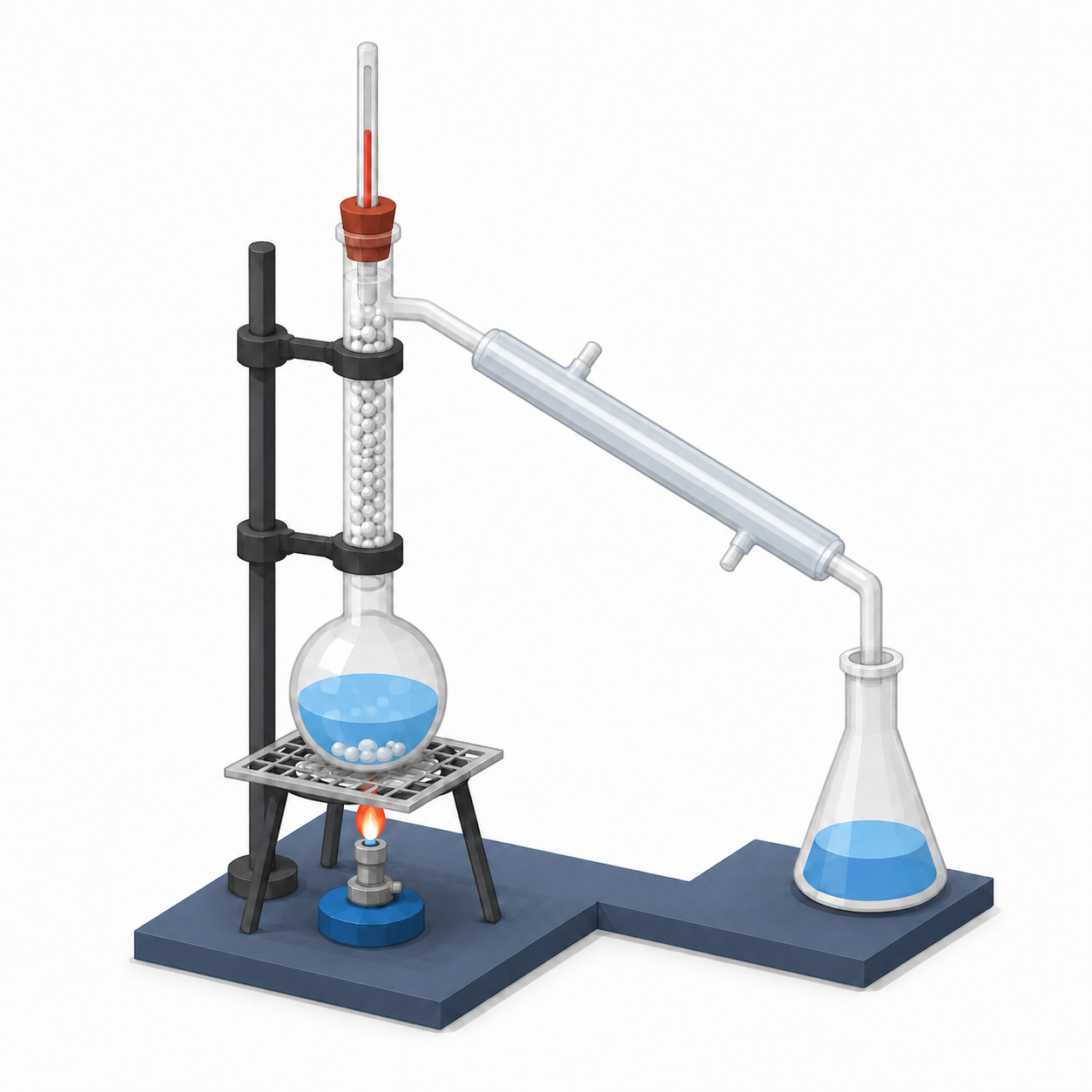
Miscible liquids (like ethanol and water) mix completely, so there is no layer to drain. Instead we use their different boiling points. A fractionating column packed with glass beads sits between the flask and the condenser. The beads give a huge surface where vapour repeatedly condenses and re-evaporates, so only the substance with the lowest boiling point makes it to the top first.
Watch the thermometer: it plateaus (stays steady) at the boiling point of whichever liquid is currently distilling over — for ethanol that is 78 °C. When the reading starts climbing again, the first liquid has finished and it is time to change receivers.
Industry runs on this idea: crude oil is split into petrol, kerosene and other fractions in giant columns; liquefied air is fractionally distilled to obtain nitrogen, oxygen and argon; and breweries use it to concentrate alcohol. Try it in the fractional distillation lab →
Chromatography — identifying what is in a mixture
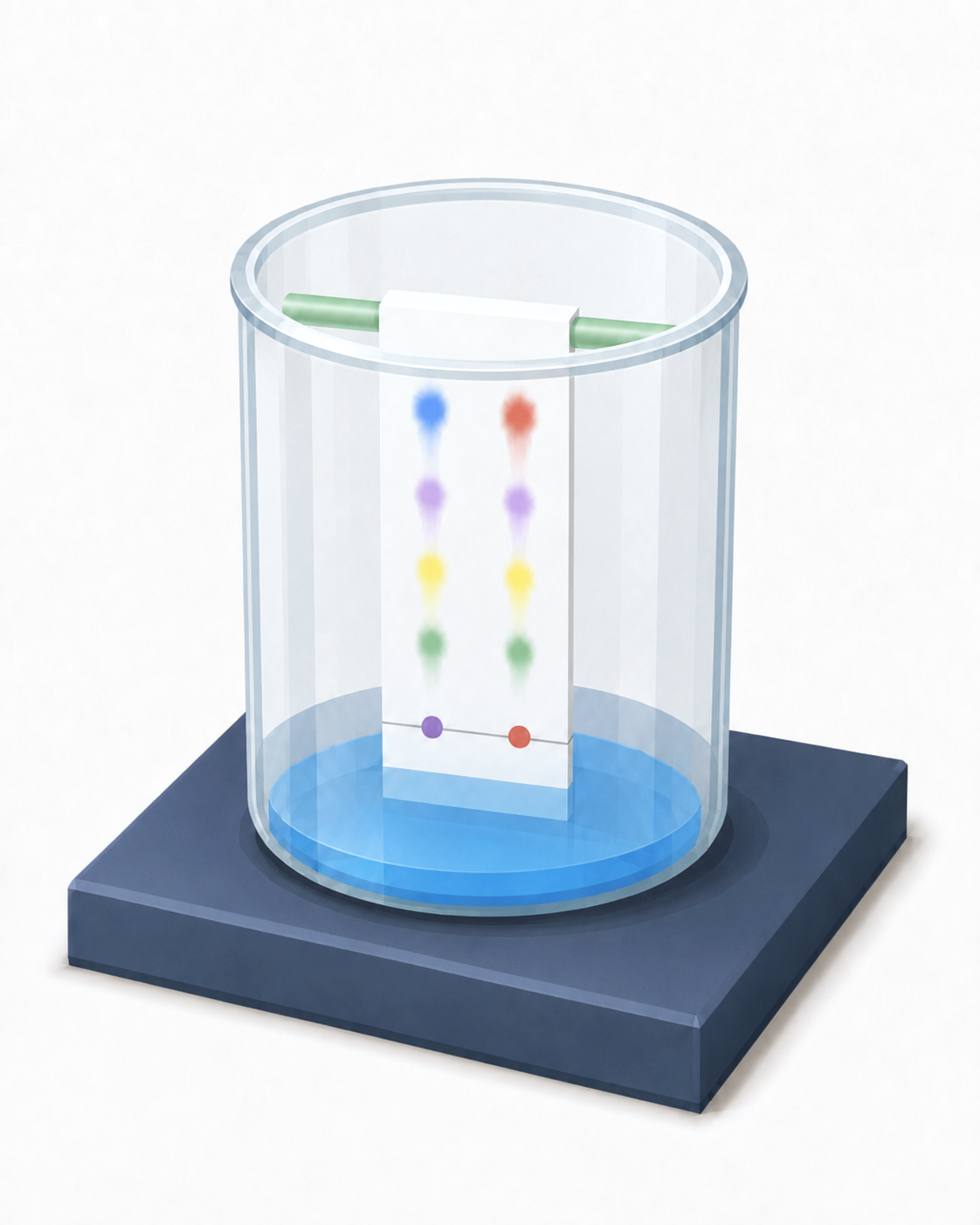
Paper chromatography separates small amounts of dissolved substances. A spot of the mixture is placed on a start line drawn in pencil near the bottom of the paper (pencil, not pen — graphite is insoluble, so the line itself cannot travel and confuse the result). The paper stands in a shallow solvent. As the solvent soaks upwards, it carries the substances with it — the more soluble a substance is in that solvent, the further it travels. The finished paper, with its separated spots, is called a chromatogram.
= distance moved by the substance ÷ distance moved by the solvent.
Under the same solvent and temperature, a substance always gives the same Rf — so you can identify an unknown spot by comparing its Rf with known substances run on the same paper.
Colourless substances such as amino acids and sugars leave invisible spots. Spray the paper with a locating agent that reacts with them to give coloured spots, or view the chromatogram under ultraviolet light.
Chromatography is used to check food additives are safe and permitted, to test athletes' samples for banned drugs, and in forensic work such as comparing inks, dyes or drugs in samples from a crime scene. Try it in the chromatography lab →
Past-paper questions
[G2 ScChem/2020/P3/Q1]MCQ
Which method is used to separate the red and blue dyes?
- D. Paper chromatography separates the dissolved dyes because they travel at different speeds through the paper with the solvent.
[G2 ScChem/2020/P3/Q1]Open-ended · adapted
Open-response adaptation: answer the cited question in words and justify your answer.
A bottle of purple ink contains a mixture of a red dye and a blue dye.Which method is used to separate the red and blue dyes?
State the correct response in full. Explain the chemistry or use the supplied data to support it; an option letter alone is not sufficient.
Correct response: paper chromatography
Paper chromatography separates the dissolved dyes because they travel at different speeds through the paper with the solvent.
[G2 ScChem/2021/P3/Q1]MCQ
- B. Paper chromatography can separate the food dyes into distinct spots.
[G2 ScChem/2021/P3/Q1]Open-ended · adapted
Open-response adaptation: answer the cited question in words and justify your answer.
Which mixture could be separated using paper chromatography?State the correct response in full. Explain the chemistry or use the supplied data to support it; an option letter alone is not sufficient.
Correct response: blue and red food dyes
Paper chromatography can separate the food dyes into distinct spots.
[G3 ScChem/2022/P1/Q3]MCQ
Paper chromatography is carried out on a mixture X and four individual dyes.
Which dyes does mixture X contain?
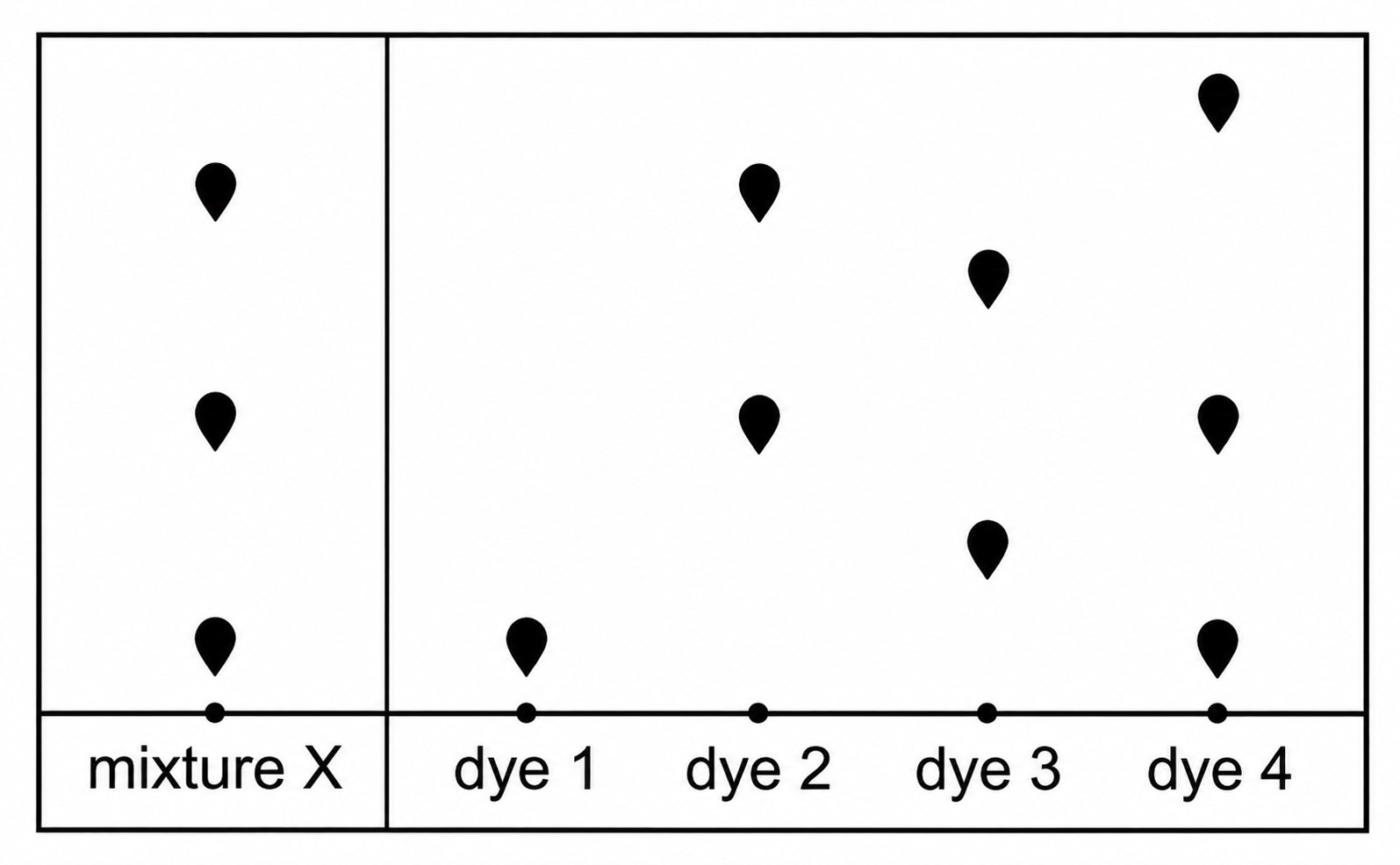
A. The three spots in mixture X match the single low spot in dye 1 and the two higher spots in dye 2.
[G3 Pure/2018/P1/Q2]MCQ
The diagram shows the results of a chromatography experiment to identify the dyes present in a sample of ink.
Which two dyes make up the ink sample?
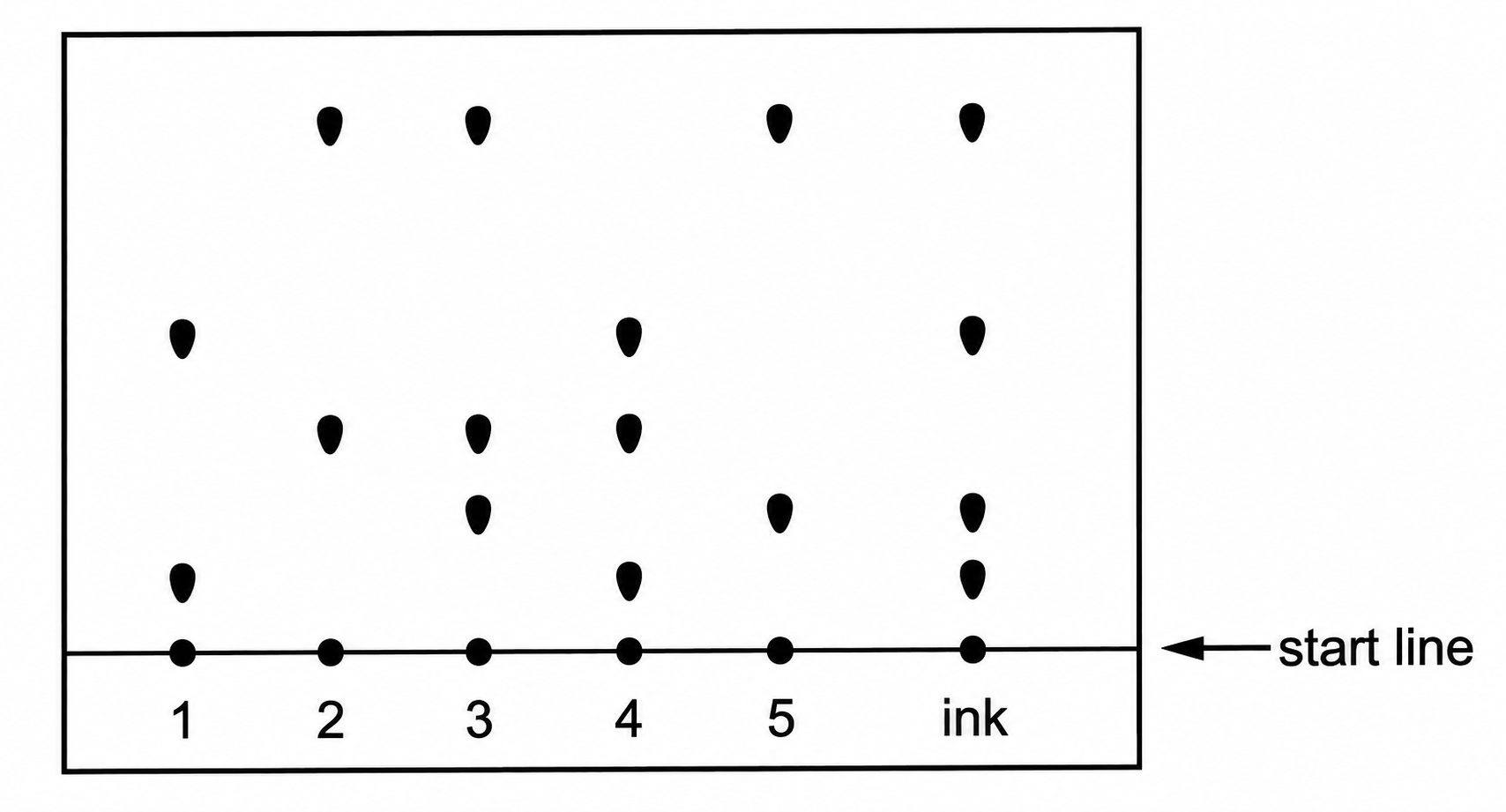
B. The four ink spots match the combined positions of the two spots in dye 1 and the two spots in dye 5.
[G3 Pure/2024/P1/Q5]MCQ
Three samples of colourless compounds, X, Y and Z, are investigated using paper chromatography. The chromatogram obtained is shown.
Which statement about the chromatography investigation is correct?
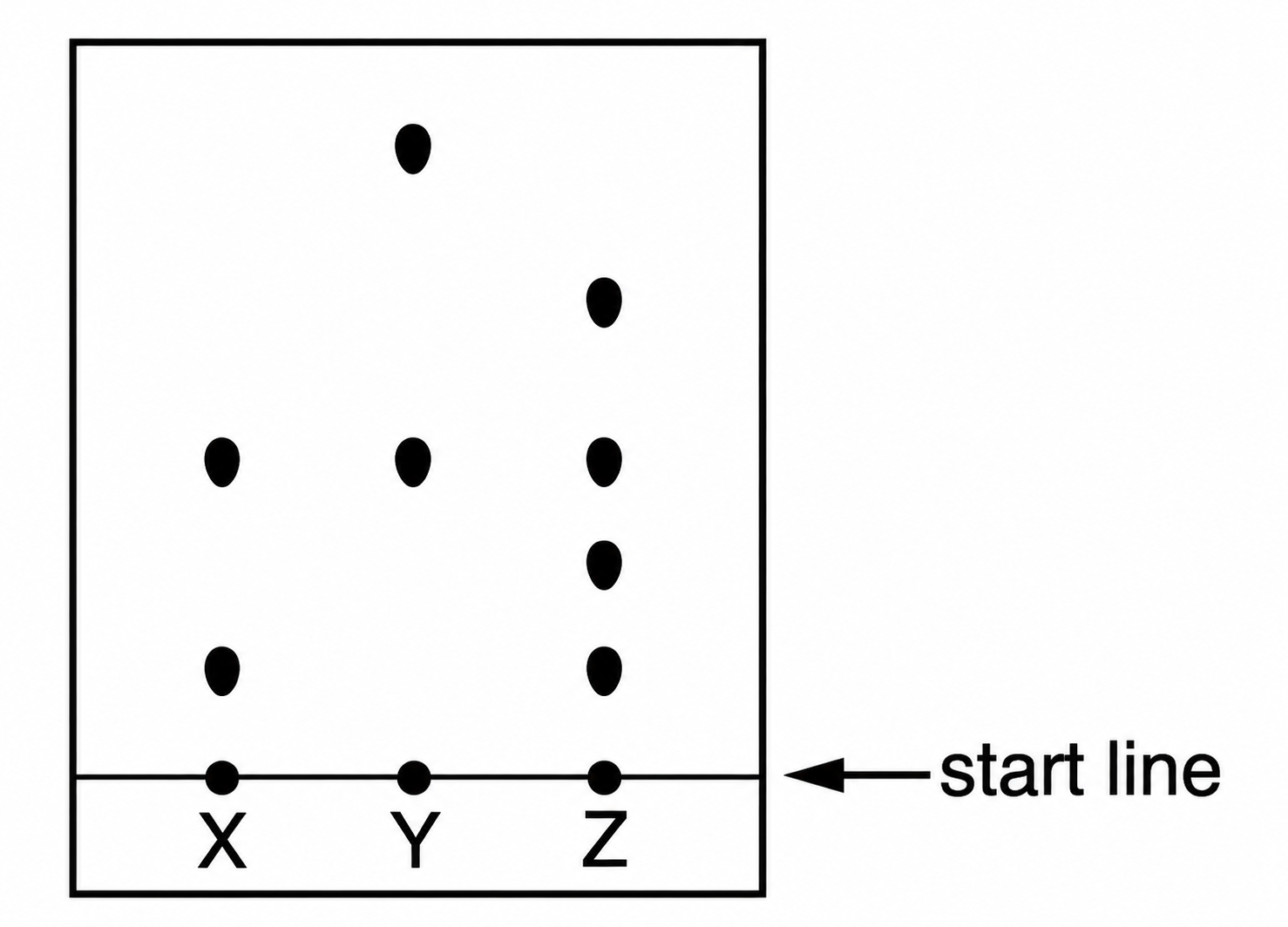
A. A locating agent is needed to show colourless compounds. X has at least two components; spot count alone does not measure percentage purity. The high spot in Y is twice, rather than half, the height of the shared middle spot.
[G3 Pure/2025/P1/Q5]MCQ
Which statement about Rf values in paper chromatography is correct?
D. Rf is the distance moved by the spot divided by the distance moved by the solvent front. It has no units and is independent of paper length under the same conditions.
Testing for purity
A pure substance contains only one substance, so it has a sharp, fixed melting point and boiling point. A mixture melts and boils over a range of temperatures instead — and the more impurity there is, the bigger the shift.
- Dissolved impurities raise the boiling point.
- Dissolved impurities lower the melting point — which is exactly why salt is spread on icy roads: salty ice melts below 0 °C.
A medicine containing the wrong impurity could harm a patient, and the silicon used for computer chips must be extraordinarily pure or the chips simply do not work.
Past-paper questions
[G2 ScChem/2017/P3/Q1]MCQ
Which substance is a pure solid at a temperature of 20 °C?
- A. A pure substance has a sharp melting point. At 20 °C, A is below its melting point of 32 °C and remains solid; D is already liquid.
[G2 ScChem/2018/P3/Q2]MCQ
What does the student check to test the purity of the crystals?
- A. Pure crystals have a sharp, characteristic melting point. Shape and size do not establish chemical purity.
[G3 ScChem/2021/P3/Q6(a)]Open-ended
A scientist is analysing three samples of impure paracetamol, a pharmaceutical drug.
The Table shows the melting point of these three samples. Each sample contains the same impurity.
| Sample | Melting point / °C |
|---|---|
| A | 165–167 |
| B | 167–169 |
| C | 168–169 |
Use information in the Table to state how the scientist knows that the three samples are impure.
Each sample melts over a range of temperatures. A pure substance has a sharp, fixed melting point.
[G3 ScChem/2024/P1/Q2]MCQ
A bottle contains a mixture of solid X and solid Y.
Some information about pure X and pure Y is shown.
| Substance | Soluble in water | Melting point / °C |
|---|---|---|
| pure X | ✓ | 133 |
| pure Y | ✗ | 154 |
The melting point of the mixture is measured.
Water is added to another sample of the mixture. The mixture is stirred and then filtered.
The residue is washed with more water and dried.
What is the melting point of the mixture of X and Y and of the dry residue produced? Each option gives the mixture melting point, then the dry residue melting point, in °C.
B. X dissolves and passes through the filter; the washed, dry residue is pure Y, which melts at 154 °C. The impure mixture melts over a lower temperature range.
[G3 ScChem/2024/P1/Q2]Open-ended · adapted
Open-response adaptation: answer the cited question in words and justify your answer.
A bottle contains a mixture of solid X and solid Y.
Some information about pure X and pure Y is shown.
| Substance | Soluble in water | Melting point / °C |
|---|---|---|
| pure X | ✓ | 133 |
| pure Y | ✗ | 154 |
The melting point of the mixture is measured.
Water is added to another sample of the mixture. The mixture is stirred and then filtered.
The residue is washed with more water and dried.
What is the melting point of the mixture of X and Y and of the dry residue produced? Each option gives the mixture melting point, then the dry residue melting point, in °C.
State the correct response in full. Explain the chemistry or use the supplied data to support it; an option letter alone is not sufficient.
Correct response: 122–124; 154
X dissolves and passes through the filter; the washed, dry residue is pure Y, which melts at 154 °C. The impure mixture melts over a lower temperature range.
[G3 Pure/2020/P1/Q4]MCQ
A colourless substance is made in an experiment.
Which are possible methods to determine if this substance is pure?
- Measure the melting point of the substance and compare with the reference value.
- Measure the boiling point of the substance and compare with the reference value.
- Test the substance using paper chromatography and a locating agent.
A. Melting/boiling points can be compared with reference values; a pure substance gives one spot under suitable chromatography conditions. A locating agent makes colourless spots visible.
Try the labs
The best way to remember a technique is to run it. Each simulation lets you set up and perform the experiment yourself:
- 🧪 Filtration — separate an insoluble solid from a liquid.
- ♨️ Evaporation — boil a solution to dryness to recover the dissolved solid.
- 🔷 Crystallisation — stop at saturation and cool for pure crystals.
- 💧 Simple distillation — recover pure water from salt water.
- 🌡️ Fractional distillation — split ethanol from water at 78 °C.
- 🫙 Separating funnel — drain oil off water, layer by layer.
- 🔮 Sublimation — catch iodine vapour on a cold flask.
- 🎨 Paper chromatography — separate an ink, then calculate and compare Rf values obtained under the same experimental conditions.
Practice
Questions are open so you can work through them in order. Answers and worked steps stay hidden until you reveal them. Your level selection filters the questions.
Measuring physical quantities
🧪 Worked examples — measuring & apparatus
Q1MCQ Delivering exactly 25.0 cm³ of solution Easy
A student needs to transfer exactly 25.0 cm³ of sodium hydroxide solution into a conical flask. Which piece of apparatus should the student use?
- The volume wanted is a single fixed volume (exactly 25.0 cm³), so pick the apparatus designed to deliver one fixed volume very accurately."Exactly 25.0 cm³" is the clue — 25.0 cm³ is the standard pipette size, and a pipette delivers its one marked volume more accurately than anything else in the list.
- Rule the others out: a beaker's markings are only rough guides; a measuring cylinder reads to the nearest 0.5 cm³; a burette is for variable volumes (any value, to 0.05 cm³) — accurate, but not what a fixed 25.0 cm³ transfer calls for.The burette is the tempting wrong answer. It is just as precise, but the question asks for one exact, fixed volume — that is the pipette's whole job.
- C — pipette.Fixed volume → pipette; variable volume → burette. Learn the pair.
Q2MCQ Three volumes, three instruments Medium
Which row shows the most suitable apparatus for measuring each of the three volumes of liquid?
| approximately 25 cm³ | exactly 25.0 cm³ | exactly 25.40 cm³ | |
|---|---|---|---|
| A | beaker | burette | pipette |
| B | beaker | pipette | measuring cylinder |
| C | measuring cylinder | pipette | beaker |
| D | measuring cylinder | pipette | burette |
- Match each volume to the kind of measurement it is. "Approximately 25 cm³" needs no great accuracy — a measuring cylinder is quick and reads to the nearest 0.5 cm³. That already eliminates A and B (a beaker's markings are rough decoration, never for measuring).The word approximately is an instruction, not filler — it tells you accuracy is not needed, so the flexible everyday instrument is the right choice.
- "Exactly 25.0 cm³" is a single fixed volume → pipette. "Exactly 25.40 cm³" is an awkward, variable volume quoted to 0.05 cm³ → burette, the only apparatus that delivers any volume that precisely.A pipette only delivers its one marked volume — it cannot do 25.40. The number of decimal places in the question is the giveaway: two decimal places means burette.
- D — measuring cylinder · pipette · burette.Rough volume → measuring cylinder; fixed exact volume → pipette; precise variable volume → burette. This three-way sort is the classic apparatus question.
Q3Open-ended Name the apparatus for each job Medium
Name the piece of apparatus most suitable for each of the following. [3]
(a) adding 23.60 cm³ of aqueous sodium hydroxide to a dilute acid
(b) measuring 4.50 g of zinc for an experiment
(c) collecting the hydrogen gas produced in a reaction and measuring its volume
- (a) 23.60 cm³ is a variable volume quoted to two decimal places, and it is being added gradually to another solution → burette. [1]Two decimal places (to 0.05 cm³) rules out everything except the burette — and a burette's tap is exactly what "adding to" a reaction needs.
- (b) 4.50 g is a mass → electronic balance. [1]Write electronic balance, not just "balance" or "weighing machine" — the qualified name is the accepted answer.
- (c) The gas must be collected and its volume measured → gas syringe. [1]Collect and measure is the cue for a gas syringe. A gas jar or a test-tube over water only collects — neither is graduated, so neither can measure a volume.
Q4Open-ended Reading a measuring cylinder — and its limits Hard
The diagram shows part of a measuring cylinder holding a sample of water.
(a) State the volume of water in the cylinder. [1]
(b) A student needs exactly 23.65 cm³ of acid for a titration.
Explain why this measuring cylinder is not suitable, and name the apparatus
the student should use instead. [2]
- (a) Read the bottom of the meniscus at eye level. Each small division is 1 cm³, and the meniscus bottom sits two divisions above the 45 mark → 47 cm³. [1]Water curves downwards (concave), so the reading is taken at the lowest point of the curve — not where the edges touch the walls.
- (b) This cylinder reads only to the nearest 0.5 cm³ (at best), but 23.65 cm³ is quoted to 0.05 cm³ — the cylinder cannot measure that precisely. [1]An accuracy explanation must compare two numbers: what the instrument can read, against what the measurement demands. "It is not accurate enough" alone earns nothing.
- Use a burette instead — it delivers any volume and is read to 0.05 cm³. [1]Not a pipette: 23.65 cm³ is not a standard fixed pipette volume. Variable and two decimal places → burette.
Collecting and drying gases
🧪 Worked examples — collecting and drying gases
Q1MCQ Measuring gas volume against time Easy
A student measures the volume of gas produced by a reaction every 20 seconds. Which pair of apparatus is most suitable?
- Two things are being measured: a gas volume and time. Pick one instrument for each: gas volume → gas syringe; "every 20 seconds" → stopwatch.Modern apparatus questions usually ask for a pair — read the stem twice and list what is actually measured before looking at the options. Burettes, pipettes and measuring cylinders all measure liquid volumes, and a thermometer measures a temperature nobody asked for.
- D — gas syringe and stopwatch.Gas volume → gas syringe; elapsed time → stopwatch. Both halves must be right — there is no partial credit in an MCQ.
Q2MCQ A gas that dissolves in water Medium
A reaction produces gas J, which is soluble in water and denser than air. Which method collects a sample of J and measures its volume accurately?
- Apply the stem's properties one at a time. Soluble in water kills option A — the gas would dissolve into the water before it could be collected.Collection over water is the method everyone draws by default, which is exactly why examiners plant the word soluble — one adjective in the stem overturns the memorised answer.
- Denser than air kills option C (upward delivery is for gases less dense than air). Option B does suit a dense gas — but a gas jar is not graduated, so it collects without measuring.Distinguish the two jobs: collect versus collect and measure. Only graduated apparatus (gas syringe, inverted burette or measuring cylinder) can measure a volume.
- D — a gas syringe: it needs no water, works for any density, and its graduations measure the volume.The gas syringe is the answer whenever the gas is soluble and a volume is wanted — it dodges both traps at once.
Q3MCQ Which apparatus does this experiment need? Medium
A student follows the progress of the reaction between hydrochloric acid and a lump of zinc carbonate by measuring the volume of gas produced over time:
ZnCO3(s) + 2HCl(aq) → ZnCl2(aq) + H2O(l) + CO2(g)
Which piece of apparatus is required?
- Look at the equation for something that can be tracked over time: the reaction gives off carbon dioxide gas. Collecting the gas and reading its volume as the reaction runs calls for a gas syringe.The experiment needs a measurable quantity that changes as the reaction proceeds. A gas product is the easiest one — the (g) state symbol in the equation is the cue.
- B — gas syringe. Nothing is being distilled, a test-tube measures nothing, and no temperature is asked for.The thermometer is the classic decoy in this kind of question — it is only relevant when the question says temperature is being tracked.
Q4Open-ended Choosing a collection method, with reasons Medium
The table gives some properties of two gases.
| gas | solubility in water | density compared with air |
|---|---|---|
| ammonia | very soluble | less dense |
| carbon dioxide | slightly soluble | denser |
Suggest a suitable method to collect each gas. Explain each choice. [4]
- Ammonia: collect by upward delivery (into an inverted gas jar). [1]Its solubility rules water out first: a very soluble gas would simply dissolve, so collection over water is impossible. That leaves the two delivery methods, and density decides between them.
- …because ammonia is less dense than air, so it rises and fills a jar held mouth-downwards. [1]The reason must name the property doing the work — "less dense than air" is the mark, not the word "upward".
- Carbon dioxide: collect by downward delivery (into an upright gas jar), because it is denser than air and sinks to fill the jar from the bottom. [1 + 1]Slightly soluble means collection over water is also acceptable for carbon dioxide — but if you choose it, say "only slightly soluble, so little gas is lost", because the reason is still the mark.
- Full-mark shape: method + property-based reason, for each gas — upward delivery / very soluble in water so cannot collect over water, and less dense than air • downward delivery / denser than air.Two marks per gas: one for a workable method, one for the property that justifies it. A method with no reason is half an answer.
Q5Open-ended Naming the apparatus properly — and sizing it Medium
A reaction is expected to produce about 80 cm³ of gas. The gas must be collected and its volume measured.
Name a suitable piece of apparatus, and explain why a 100 cm³ one is chosen rather than a 50 cm³ one. [2]
- A calibrated (graduated) gas syringe — it both collects the gas and measures its volume. [1]In an open-ended answer, qualify the apparatus: calibrated / graduated gas syringe is the full-mark form, because the graduations are what make it a measuring instrument.
- The syringe must hold more gas than the reaction produces: 80 cm³ would overflow a 50 cm³ syringe (gas would escape and the reading would be lost), so the 100 cm³ syringe is the suitable size. [1]Capacity answers compare the expected volume with the instrument's maximum — quote both numbers. This "is it big enough?" check is a standard mark whenever a volume is given in the question.
Collecting and drying gases
Q6Open-ended Drying a gas without destroying it ✕ G3/G2 ScChem Hard
A student prepares carbon dioxide and needs a dry sample of the gas.
(a) Describe how the gas can be dried. [1]
(b) Name a suitable drying agent for carbon dioxide. [1]
(c) Explain why quicklime (calcium oxide) must not be used to dry carbon
dioxide. [1]
- (a) Pass the gas through (or over) a drying agent before collecting it. [1]Drying happens on the way to the collection vessel — typically bubbling through concentrated sulfuric acid in a bottle, or passing over a solid drying agent in a U-tube.
- (b) Concentrated sulfuric acid (or fused calcium chloride). [1]Both are inert towards carbon dioxide, so they remove the water without touching the gas itself.
- (c) Quicklime is a base, and carbon dioxide is an acidic gas — they would react (forming calcium carbonate), so the drying agent would absorb the very gas being collected. [1]The rule for every drying-agent question: the agent must not react with the gas. Acidic gas → never a basic drying agent; alkaline gas (ammonia) → never concentrated sulfuric acid.
Choosing a separation technique
🧪 Worked examples — choosing and using separation techniques
Q1MCQ Matching a technique to its job Easy
Which row correctly pairs a separation technique with its function?
- Test each row against what the technique actually delivers. Filtration traps an insoluble solid — sand — on the filter paper, so row B works.Every technique recovers a specific kind of component. Ask "what ends up where?" — residue on the paper, filtrate through it.
- The others are crossed: distillation recovers the water (the solvent), not the salt; crystallisation recovers the salt (the dissolved solid), not the water; chromatography identifies small amounts of dissolved substances — it is not a bulk-recovery method at all.A and C swap each other's products — the most common mix-up in this topic. Distillation keeps the solvent; crystallisation keeps the solute.
- B — filtration separates insoluble sand from seawater.Insoluble solid + liquid → filtration. The word insoluble is the trigger.
Q2MCQ The right sequence of steps Medium
A mixture contains insoluble silver chloride and soluble sodium chloride, both white solids. Which sequence gives pure sodium chloride?
- The two solids look identical, so separate them by the property they do not share: solubility. First add water — the sodium chloride dissolves, the silver chloride does not.You cannot filter a dry mixture of two solids — both would stay on the paper. Options C and D fail at step one for exactly that reason.
- Now filter: silver chloride is caught as the residue; sodium chloride solution passes through as the filtrate. Skipping this step (option A) would evaporate the water away and leave both solids mixed again.Each step must remove one component. Track where each substance is after every step — option A never removes the silver chloride at all.
- B — add water, filter, then evaporate the filtrate to recover the sodium chloride.Evaporation to dryness is acceptable here because sodium chloride is heat-stable. If the question said the solid decomposes on heating, the last step would have to be crystallisation instead — watch for that clue.
Q3Open-ended Pure dry salt from a sand–salt mixture Medium
A student is given a mixture of sand and common salt (sodium chloride). Describe how the student can obtain a sample of pure, dry salt from the mixture. [4]
- Add water to the mixture and stir — the salt dissolves, but the sand does not.Separation always exploits a property the two components do not share. Here it is solubility in water: salt is soluble, sand is insoluble. Naming the solvent (water) earns the mark — "dissolve it" alone does not say in what.
- Filter the mixture. The sand is trapped on the filter paper as the residue; the salt solution passes through as the filtrate.Filtration removes an insoluble solid from a liquid. Use the technical words residue and filtrate — examiners look for them.
- Heat the filtrate to evaporate most of the water, then leave the hot, concentrated solution to cool and crystallise.Evaporation removes the solvent from the filtrate to recover the dissolved salt. (Sodium chloride is heat-stable, so evaporating to dryness also scores here — crystallisation is the safer habit for salts that decompose on strong heating.)
- Dry the crystals by pressing them between sheets of filter paper (or leaving them in a warm oven). The four marks: add water and stir • filter — sand is the residue • evaporate / crystallise the filtrate • dry the crystals.The question asks for pure, dry salt — the drying step is a mark, and stopping at "filter" loses the two marks that recover the salt from the filtrate.
Q4MCQ When the usual method is the trap Hard
A mixture contains two white solids, P and Q.
| solid | solubility in water | effect of heat |
|---|---|---|
| P | soluble | decomposes on heating |
| Q | insoluble | no effect |
Which steps separate the two solids correctly?
- The route starts the usual way: add water (P dissolves, Q does not), then filter (Q is the residue). Options C and D try to filter a dry solid–solid mixture first, which separates nothing.Filtration only works once one component is dissolved — water must come first.
- Now the deciding clue: P decomposes on heating. Evaporating the filtrate to dryness would boil P strongly and destroy it — so recover P by crystallisation: evaporate only until saturated, then cool and let crystals form.One sentence in the table turns the "usual" last step into the wrong answer. Whenever a question plants a property like decomposes on heating, it is there to overrule your memorised default.
- A — dissolve in water, filter, crystallise the filtrate.Heat-stable solute → evaporation to dryness is fine; heat-fragile solute → crystallisation. The table always tells you which case you are in.
Q5Open-ended Designing a route from a solubility table Hard
The table shows the solubility of two solids, R and S, in liquid X. Neither solid decomposes on heating, and liquid X is safe to boil away.
| solid | solubility in liquid X |
|---|---|
| R | insoluble |
| S | soluble |
Describe how to obtain pure, dry samples of both R and S from a mixture of the two solids. [4]
- Shake the mixture with liquid X and stir — S dissolves, R does not. [1]The table is the whole question: it hands you the one property the solids do not share. Name the liquid you add — "add a solvent" is too vague to score.
- Filter. R is trapped as the residue; the solution of S in X passes through as the filtrate. [1]State where each substance ends up — the examiner is checking you can track both components, not just name the technique.
- Wash the residue with a little more of liquid X and dry it (press between filter papers or leave in a warm oven) → pure, dry R. [1]Unwashed residue is still wet with the filtrate — traces of S would dry onto R, so it would not be pure. The washing step is what "pure" is worth here.
- Heat the filtrate to evaporate liquid X to dryness (safe here — S does not decompose) → pure, dry S. [1] Four marks: dissolve in X • filter, R = residue • wash and dry R • evaporate the filtrate for S.Both products were asked for — a route that recovers only one of them caps the marks at two. Read the question's last line before writing.
Separating liquid–liquid mixtures
🧪 Worked examples — chromatography
Q1MCQ Setting up the paper correctly Easy
A student sets up a paper chromatography experiment to separate the dyes in a food colouring. Which row is correct?
- The start line must be drawn in pencil. Ink is itself a mixture of dyes — it would dissolve in the solvent and run up the paper with the sample, ruining the chromatogram.Every rule in this set-up exists to protect the experiment. Ask "what would go wrong otherwise?" and the correct option explains itself.
- The start line (with its sample spot) must sit above the solvent level — if the spot started under the surface, the dyes would simply dissolve off into the solvent instead of travelling up the paper. Answer: C.Pencil line, spot above the solvent — the two set-up facts examiners test again and again.
Q2MCQ Which sweets are unsafe? Medium
The chromatogram shows the dyes in four sweets, W, X, Y and Z, alongside two harmful dyes, I and II. Which sweets are not safe to eat?
- Rule a light line across the chromatogram at the height of dye I's spot, and another at dye II's. A sweet contains a harmful dye only if one of its spots sits at exactly the same height as that dye's spot.Same substance → same height on the same chromatogram, because both spots travelled under identical conditions. Height is the fingerprint — spot colour helps, but the height match is the evidence.
- Check each sweet: W's spots line up with neither I nor II. X has a spot level with dye I. Y matches neither. Z has a spot level with dye II.Work lane by lane and say yes/no for each — jumping straight to a "likely pair" is how the half-right options catch people.
- D — X and Z are unsafe: X contains harmful dye I, and Z contains harmful dye II.The other options each include a sweet (W or Y) whose spots match neither harmful dye — one correct half does not make an option correct.
Q3Open-ended Plan the experiment: how many dyes? Medium
Food colourings are often made by mixing several dyes. Describe how you would find out, in the laboratory, how many dyes a sample of food colouring contains. Include the apparatus you would use and how you would read the result. [4]
- Draw a start line in pencil near the bottom of a strip of chromatography paper, and put a small spot of the food colouring on the line. [1]Pencil, because ink would run with the sample. A small concentrated spot gives sharp separated spots instead of smears.
- Stand the paper in a beaker of solvent (water) with the start line above the solvent level, and cover the beaker. [1]Below the surface, the spot would wash off into the solvent. The lid stops the solvent evaporating from the paper mid-run.
- Let the solvent rise up the paper, carrying the dyes with it, until it nearly reaches the top — then remove the paper and mark the solvent front. [1]Marking the solvent front fixes the end-point of the run — without it the chromatogram cannot be compared with anything later.
- Count the spots on the dried chromatogram: the number of separate spots is the number of dyes in the colouring. [1]Strictly, it is the number of dyes at least — two dyes that travel identically would sit on top of each other. At O-Level, "number of spots = number of dyes" earns the mark; the "at least" caveat is the polished answer.
Q4Open-ended Reading a finished chromatogram Medium
The chromatogram shows three known dyes, E, F and G, and a mixture M.
(a) Which of the dyes E, F and G does M contain? Explain how you can tell. [2]
(b) Is M a pure substance? Give a reason. [1]
(c) Which dye is the most soluble in the solvent? [1]
- (a) M contains E and G: M shows spots at the same heights as both of E's spots and as G's spot. [1 + 1]The creditable sentence shape is "contains X because there is a spot at the same height as X". Naming the dyes without citing the matching heights is the classic half-answer.
- M does not contain F — nothing in M's lane sits at the height of F's green spot.Say what is absent as well as what is present when the question asks "which of the dyes" — it shows the comparison was actually made.
- (b) No — M is a mixture, because its lane shows more than one spot (three). [1]One spot → (probably) pure; several spots → definitely a mixture. Always attach the evidence: "because it gives three spots".
- (c) The purple dye (G) — its spot travelled furthest up the paper, so it is the most soluble in the solvent and moved fastest with it. [1]Further up = more soluble. And note the low amber spot is the least soluble — never call it "insoluble": an insoluble dye would still be sitting on the start line.
Separating liquid–liquid mixtures
Q5Open-ended Calculating and using Rf ✕ G3/G2 ScChem Hard
In a chromatography experiment, a dye spot travels 4.2 cm from the start line while the solvent front travels 8.4 cm. The table gives the Rf values of three dyes measured under the same conditions.
| dye | Rf |
|---|---|
| fast yellow | 0.79 |
| allura red | 0.50 |
| brilliant blue | 0.35 |
(a) Calculate the Rf value of the spot. [1]
(b) Identify the dye. [1]
(c) Explain why Rf values can be used to identify a dye only if the
chromatograms are run under the same conditions. [1]
- (a) Rf = distance moved by the substance ÷ distance moved by the solvent = 4.2 ÷ 8.4 = 0.50. [1]Both distances are measured from the start line, and the substance's distance goes on top. Rf has no units and is never greater than 1 — a spot cannot outrun the solvent that carries it.
- (b) Rf 0.50 matches allura red in the table. [1]Identification is a straight table look-up once the ratio is computed — state the dye's name, not just "the second one".
- (c) A dye's Rf is constant only for a given solvent (and paper and temperature). Changing the conditions changes how far the dye travels relative to the solvent — so Rf values can only be compared between chromatograms run under the same conditions. [1]Rf is a fingerprint of the dye–solvent–paper combination, not of the dye alone. That is why the reference table must say "measured under the same conditions".
Testing for purity
🧪 Worked examples — testing for purity
Q1MCQ Proving a liquid is pure water Easy
A liquid boils at 100 °C. Which other property confirms that it is pure water?
- Purity is judged by fixed physical constants — melting point and boiling point. The boiling point (100 °C) is given, so the confirming evidence is the other constant: freezing at exactly 0 °C.Being colourless or neutral describes many liquids, and a dissolved impurity like ethanol would also leave no residue — none of those pin the identity down. Only the pair of exact fixed points does.
- B — it freezes at exactly 0 °C.Pure substance ↔ sharp, fixed melting and boiling points. Two constants make the identification; one alone does not.
Q2MCQ Liquid at 20 °C — which data fit? Medium
Element E is a liquid at 20 °C. What could its melting point and boiling point be?
| melting point / °C | boiling point / °C | |
|---|---|---|
| A | −22 | −3 |
| B | −8 | −33 |
| C | −7 | 59 |
| D | 25 | 103 |
- A substance is liquid between its melting point and its boiling point. So the condition is: melting point below 20 °C and boiling point above 20 °C.Turn the words into an inequality before touching the options — it converts a "judgement" question into a simple check.
- Test each row against mp < 20 < bp. A: boils at −3, so at 20 °C it is a gas. B is impossible outright — a boiling point cannot be lower than the melting point. D: melts at 25, so at 20 °C it is still a solid.Row B is a "nonsense row" — exam tables often include one physically impossible option, and spotting it fast saves time.
- C — melts at −7 °C and boils at 59 °C, so at 20 °C it sits between the two: a liquid.mp < room temperature < bp is the whole test for "liquid at room temperature".
Q3MCQ The impure sample and the true melting point Hard
The melting point of a sample of impure benzoic acid is measured five times:
| experiment | 1 | 2 | 3 | 4 | 5 |
|---|---|---|---|---|---|
| melting point / °C | 118 | 119 | 114 | 112 | 117 |
Which temperature is most likely to be the melting point of pure benzoic acid?
- Recall the effect of an impurity: it lowers the melting point (and makes melting happen over a range — which is why the five readings scatter from 112 to 119).The scatter is not "experimental error" to be averaged away — it is the impurity itself at work. That reframing is the whole question.
- Every measured value comes from the impure sample, so every one of them sits below the true melting point. The pure value must be higher than all five readings — higher than 119 °C.Averaging to 116 °C (option B) is the planted trap: an average of systematically lowered values is still a lowered value.
- D — 121 °C, the only option above every impure reading.Impurity lowers the melting point → pure > every impure measurement. Logic, not arithmetic, answers this one.
Q4Open-ended Two experiments, two purity checks Medium
For each experiment, state the observation that shows the sample being analysed is a pure substance. [2]
(a) carry out paper chromatography on the sample
(b) measure the melting point of the sample
- (a) The chromatogram shows only one spot. [1]A pure substance is a single substance, so there is nothing to separate — several spots would mean a mixture.
- (b) The sample melts completely at one sharp, fixed temperature (equal to the known melting point of the substance). [1]The two halves of the answer both matter: sharp (not over a range — an impure solid melts across several degrees) and at the known value (an impurity would push the melting point below it).
Q5Open-ended What salt does to water's fixed points Hard
Sodium chloride is dissolved in a sample of pure water.
(a) State how the salt changes the melting point and the boiling point of the
water. [2]
(b) Sea water is mostly water with dissolved salts. Suggest why sea water boils
at a temperature above 100 °C, and why it boils over a
range of temperatures rather than at one fixed value. [1]
- (a) The dissolved salt lowers the melting point (the salt water freezes below 0 °C)… [1]An impurity always widens the liquid range from both ends. This is exactly why salt is spread on icy roads in cold countries — salty ice melts below 0 °C.
- …and raises the boiling point (the salt water boils above 100 °C). [1]Learn the pair as one fact: impurity → melting point down, boiling point up. Options that move both the same way are always wrong.
- (b) Sea water is a mixture, and its dissolved salts are an impurity — so it boils above 100 °C, and, being a mixture, it boils over a range of temperatures instead of at one sharp value. [1]Fixed sharp values belong to pure substances only. "Mixture → melts/boils over a range" is the sentence the mark scheme looks for.
Syllabus at a glance (2023)
What topic 1 Experimental Chemistry asks you to be able to do. The three syllabuses word their outcomes differently — pick your own tab to see exactly what you are assessed on.
G3 Pure Chemistry — the full Chemistry syllabus — these notes are written to it.
| LO | What you must be able to do — 2023 O-Level Chemistry | Covered in |
|---|---|---|
| 1.1(a) | name appropriate apparatus for the measurement of time, temperature, mass and volume; including burettes, pipettes, measuring cylinders and gas syringes | Measuring |
| 1.1(b) | suggest suitable apparatus, given relevant information, for a variety of simple experiments, including drying and collection of gases and measurement of rates of reaction (drying agents will be limited to calcium oxide, concentrated sulfuric acid and fused calcium chloride) | Gases |
| 1.2(a) | describe methods of separation and purification for the components of mixtures, to include: (i) use of a suitable solvent, filtration and crystallisation or evaporation (ii) sublimation (iii) distillation and fractional distillation (see also 11.1(b)) (iv) use of a separating funnel (v) paper chromatography | Choosing |
| 1.2(b) | suggest suitable separation and purification methods, given information about the substances involved in the following types of mixtures: (i) solid-solid (ii) solid-liquid (iii) liquid-liquid (miscible and immiscible) | Choosing |
| 1.2(c) | interpret paper chromatograms including comparison with 'known' samples and the use of Rf values | Chromatography |
| 1.2(d) | explain the need to use locating agents in the chromatography of colourless compounds (knowledge of specific locating agents is not required) | Chromatography |
| 1.2(e) | deduce from the given melting point and boiling point data the identities of substances and their purity | Purity |
| 1.2(f) | explain the importance of measuring the purity in substances used in everyday life, e.g. foodstuffs and drugs | Purity |
G3 Science (Chemistry) — fewer outcomes than Pure, and several are worded more simply.
| LO | What you must be able to do — 2023 O-Level Science (Chemistry) | Covered in |
|---|---|---|
| 1.1(a) | name appropriate apparatus for the measurement of time, temperature, mass and volume; including burettes, pipettes, measuring cylinders and gas syringes | Measuring |
| 1.1(b) | suggest suitable apparatus, given relevant information, for a variety of simple experiments, including collection of gases and measurement of rates of reaction | Gases |
| 1.2(a) | describe methods of separation and purification for the components of mixtures, to include: (i) use of a suitable solvent, filtration and crystallisation or evaporation (ii) distillation and fractional distillation (see also 11.1(b)) (iii) paper chromatography | Choosing |
| 1.2(b) | suggest suitable separation and purification methods, given information about the substances involved in the following types of mixtures: (i) solid-solid (ii) solid-liquid (iii) liquid-liquid (miscible) | Choosing |
| 1.2(c) | interpret paper chromatograms including comparison with 'known' samples (the use of Rf values is not required) | Chromatography |
| 1.2(d) | deduce from the given melting point and boiling point data the identities of substances and their purity | Purity |
G2 Science (Chemistry) — the smallest set — some whole topics are not examined.
| LO | What you must be able to do — 2023 N-Level Science (Chemistry) | Covered in |
|---|---|---|
| 1.1(a) | name appropriate apparatus for the measurement of time, temperature, mass and volume; including burettes, pipettes, measuring cylinders and gas syringes | Measuring |
| 1.1(b) | suggest suitable apparatus, given relevant information, for a variety of simple experiments, including collection of gases | Gases |
| 1.2(a) | describe methods of separation and purification for the components of mixtures, to include: (i) use of a suitable solvent, filtration and crystallisation or evaporation (ii) distillation and fractional distillation (see also 8.1(b)) (iii) paper chromatography | Choosing |
| 1.2(b) | suggest suitable separation and purification methods, given information about the substances involved in the following types of mixtures: (i) solid-solid (ii) solid-liquid (iii) liquid-liquid (miscible) | Choosing |
| 1.2(c) | interpret paper chromatograms including comparison with 'known' samples (the use of Rf values is not required) | Chromatography |
| 1.2(d) | deduce from the given melting point and boiling point data the identities of substances and their purity | Purity |
All three side by side, in the same rows as the MOE comparison document. Highlighted wording is where the syllabuses differ; – means that syllabus does not ask for it. Note the letters drift out of step once an outcome is dropped.
| G3 Pure2023 O-Level Chemistry | G3 ScChem2023 O-Level Science (Chemistry) | G2 ScChem2023 N-Level Science (Chemistry) |
|---|---|---|
| 1.1(a) name appropriate apparatus for the measurement of time, temperature, mass and volume; including burettes, pipettes, measuring cylinders and gas syringes | 1.1(a) name appropriate apparatus for the measurement of time, temperature, mass and volume; including burettes, pipettes, measuring cylinders and gas syringes | 1.1(a) name appropriate apparatus for the measurement of time, temperature, mass and volume; including burettes, pipettes, measuring cylinders and gas syringes |
| 1.1(b) suggest suitable apparatus, given relevant information, for a variety of simple experiments, including drying and collection of gases and measurement of rates of reaction (drying agents will be limited to calcium oxide, concentrated sulfuric acid and fused calcium chloride) | 1.1(b) suggest suitable apparatus, given relevant information, for a variety of simple experiments, including collection of gases and measurement of rates of reaction | 1.1(b) suggest suitable apparatus, given relevant information, for a variety of simple experiments, including collection of gases |
| 1.2(a) describe methods of separation and purification for the components of mixtures, to include: (i) use of a suitable solvent, filtration and crystallisation or evaporation (ii) sublimation (iii) distillation and fractional distillation (see also 11.1(b)) (iv) use of a separating funnel (v) paper chromatography | 1.2(a) describe methods of separation and purification for the components of mixtures, to include: (i) use of a suitable solvent, filtration and crystallisation or evaporation (ii) distillation and fractional distillation (see also 11.1(b)) (iii) paper chromatography | 1.2(a) describe methods of separation and purification for the components of mixtures, to include: (i) use of a suitable solvent, filtration and crystallisation or evaporation (ii) distillation and fractional distillation (see also 8.1(b)) (iii) paper chromatography |
| 1.2(b) suggest suitable separation and purification methods, given information about the substances involved in the following types of mixtures: (i) solid-solid (ii) solid-liquid (iii) liquid-liquid (miscible and immiscible) | 1.2(b) suggest suitable separation and purification methods, given information about the substances involved in the following types of mixtures: (i) solid-solid (ii) solid-liquid (iii) liquid-liquid (miscible) | 1.2(b) suggest suitable separation and purification methods, given information about the substances involved in the following types of mixtures: (i) solid-solid (ii) solid-liquid (iii) liquid-liquid (miscible) |
| 1.2(c) interpret paper chromatograms including comparison with 'known' samples and the use of Rf values | 1.2(c) interpret paper chromatograms including comparison with 'known' samples (the use of Rf values is not required) | 1.2(c) interpret paper chromatograms including comparison with 'known' samples (the use of Rf values is not required) |
| 1.2(d) explain the need to use locating agents in the chromatography of colourless compounds (knowledge of specific locating agents is not required) | – | – |
| 1.2(e) deduce from the given melting point and boiling point data the identities of substances and their purity | 1.2(d) deduce from the given melting point and boiling point data the identities of substances and their purity | 1.2(d) deduce from the given melting point and boiling point data the identities of substances and their purity |
| 1.2(f) explain the importance of measuring the purity in substances used in everyday life, e.g. foodstuffs and drugs | – | – |
Wording is quoted verbatim from the 2023 syllabuses. G3 Pure = O-Level Chemistry · G3 ScChem = O-Level Science (Chemistry) · G2 ScChem = N-Level Science (Chemistry). Numbering differs between them: G2 ScChem has no Redox, Chemical Energetics or Rate of Reactions, so its later topics are numbered lower.